| Botanical Name |
|
| Family |
Aloeaceae - The aloe family. |
| Pronunciation |
|
| Common Name(s) |
Afrikaans: boomaalwyn; mikaalwyn
IsiXhosa: Ikhala; Umgxwala; Uphondonde
IsiZulu: umGxwala; Indlabendlazi; Umhlalampofu
|
| Plant Group |
- Tree A woody, self-supporting perennial plant usually with a single main stem and generally growing more than 6 meters tall.
|
| Plant Size |
- Medium
| Tree | 10m to 16m |
| Shrub | 1m to 2m |
| Perennial/ground cover | 40cm to 60cm |
| Bulb | 40cm to 60cm |
| Succulent | 40cm to 60cm |
|
| Position |
- Canopy Shade Canopy shade is found below closely grown trees where some light filters through. Ideal for the protection of herbaceous plants.
- Light or Dappled Shade Found below trees with sparse, open foliage. Ideal for the protection of herbaceous plants.
- Partial Shade The area is in shade for part of the day and in full sun for part of the day.
- Sun The area is in full sun for all or most of the day, all year round.
|
| General Information |
- Drought Tolerance: High The plant is well adapted to arid conditions; it can survive long periods of drought and high temperatures without extra water.
- Evergreen Plants that have leaves all year round.
- Frost: Half-hardy The plant is able to survive low temperatures and some frost but requires protection against severe frost.
- Roots Invasive Do not plant near pools, paving, walls or buildings.
- Water Moderate These plants will need some extra watering compared to water-wise plants. Plant them together, in at least some shade and in a convenient proximity to the house so that grey water can be utilised during times of drought.
- Wind Tolerant Plants able to withstand the effect of strong winds.
|
| Specific Information |
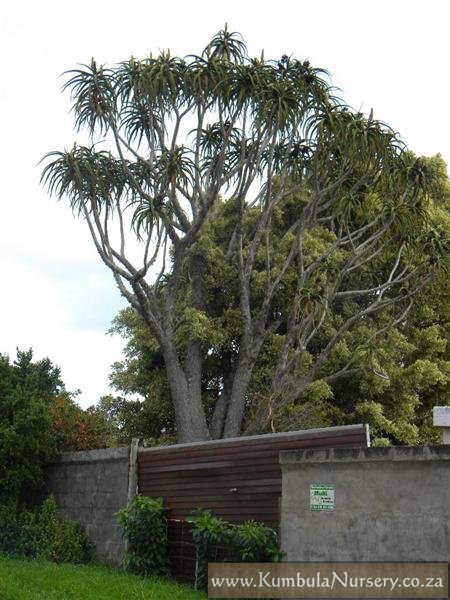
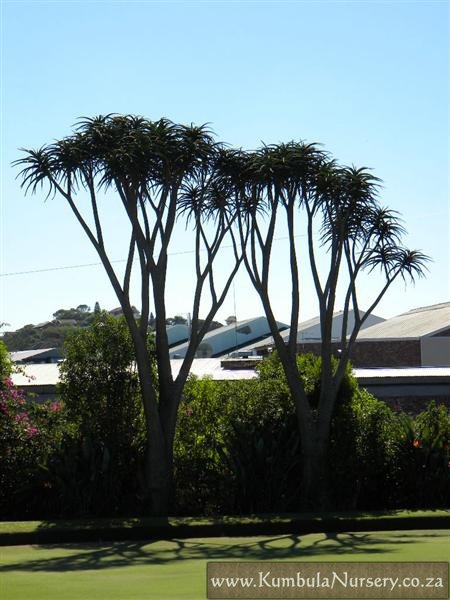
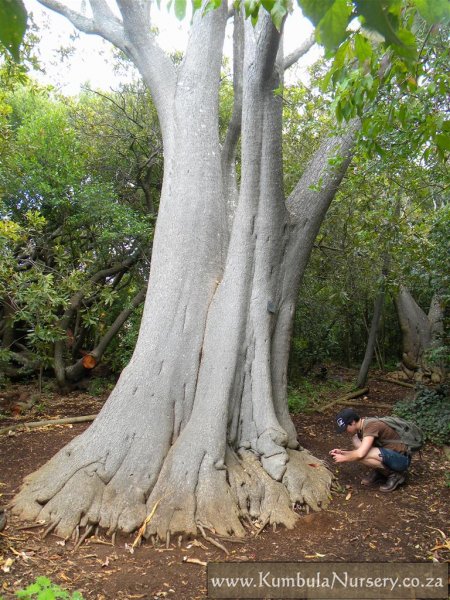
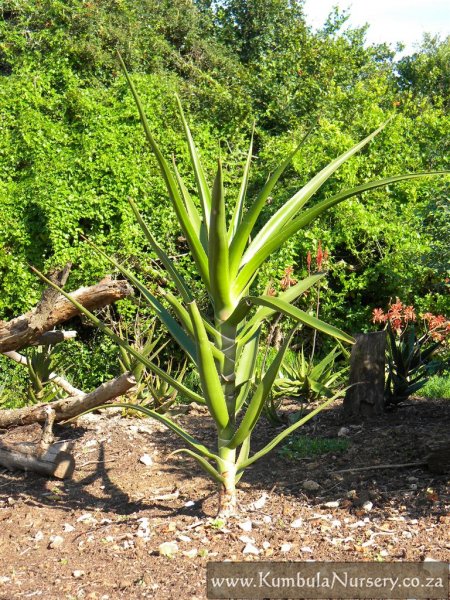
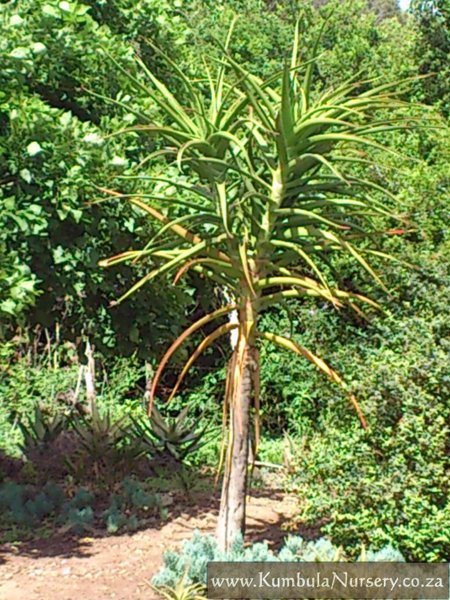
Aloe Barberae, Africa's largest aloe, has a neat, rounded crown, grey, smooth bark and dense rosettes of leaves. It forms a sculptural focal point in the garden. As specimens age they develop a massive stem base - note picture three above. It would be wise not to plant this tree too close to permanent structures, pools or paving. Aloe Barberea is found in mild climates in river valleys and coastal forests but I have had (unverified) reports of this aloe being grown successfully in Bloemfontein, Gauteng and Cape Town.
|
| Ad Break |
|
| Flowers |
| Description |
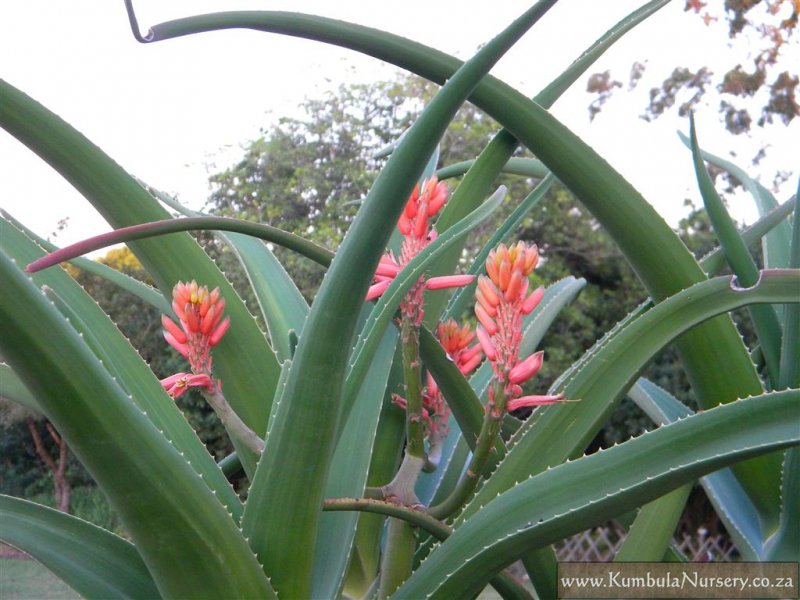
tubular flowers clustered on the ends of upright spikes
|
| Season |
- Winter Plants will seldom bloom for the entire season as given in the list, but should flower during a period within these parameters.
|
| Colour |
|
| Growth Rate |
- Moderate to Fast Specifying growth rate can be very misleading as there is considerable variation of growth rate depending on type and species of plant, available water, supplementary feeding, mulching and general care, as well as the plants suitability and adaptability to the garden environment.
|
| Plant Uses |
- Accent or Focal Point A plant used to attract the attention because of its colour or form.
- Attracts bees, butterflies or other insects This plant attracts insects which can be food for birds or other creatures in your garden.
- Attracts Birds This plant will attract birds.
- Boundary A plant useful for planting around the edges of the property to form a green or colourful backdrop, an impenetrable hedge, to hide walls or create privacy.
- Container Trees, shrubs and ornamental species that can adapt to growing in a restricted environment.
- Rock Garden An area constructed of larger rocks, arranged naturally, to emphasise the use of stones as a main element. Generally plants used do not need a lot of care.
- Suitable for coastal gardens Plants adapted to dry, sandy soil, forceful wind, limited rainfall and intense sunlight.
- Wild Garden An indigenous garden planted for the benefit of wildlife and birds. Provides food, water, a variety of mini-biomes and no poisonous chemicals are used.
|
| Distribution and Habitat |
from East London in Eastern Cape to KwaZulu-Natal and Mpumalanga, as well as , Mozambique further north to East Africa, in dry forests or dense tall woodland, generally in east-facing kloofs, river valleys and occasionally in exposed rocky places
|
| Planting Suggestions |
Aloe Barberae needs well-drained soil, preferably on a slope. It should be well watered and be given enough compost to provide for optimal growth. In areas where frost is experienced, it should be protected in the first few years. Ensure enough space for its eventual size.
|
| Medicinal Uses |
|
| Ad Break |
|






Comments
Aloe barberae
I have 4,very large Aloes bareraes, but would like to plant more on the farm. What would you recommend? Can I cut some branches and replant them?
Thank you
Aloe barberae: planting truncheons
Hi Stephan
Generating new plants from the stems is easy and effective. Cut sturdy stems with one head, anything from 0,8 to 1,3 meters long. Leave them in the shade for 3 to 4 weeks so that the ends dry out well. Plant securely in well-drained soil, and water well. Keep the soil slightly moist, never very wet or very dry. A liter or two of coarse sand at the base of the holes will help to prevent water-logging. Rooting will take place but will be quite a slow process. You can use a rooting hormone but I have never bothered to do this with aloes. The truncheons can be planted in a holding bed, where watering is more easily controlled, or into large bags holding about 20 liters of soil, or directly into position. They should be rooted in about 4 months - maybe longer depending on local circumstances.
Hope you have success.
Kind regards
Lorraine
Plant truncheons wet
Hi Lorraine
I have planted 25 Aloe barberae, and not knowing the information above about making sure the ends are well dry, I cut off the dry part as I thought it was dead.I then dipped the ends into a bucket of water and sprinkled the wet end with a rooting hormone and planted into a hole with river sand at the bottom and filled the hole hole up with river sand. Only I saw your site first!! What should I do? I have around another 30 to still plant. Regards Brett
Planting truncheons
Hi Brett
Oh dear! Oops!
In your position I would lift all the aloes, put them in a shady spot and let them dry out for at least a week if the weather is very hot and dry, but they should be left to dry for at least 3 to 4 weeks. The cut end must be thoroughly dry. I have left aloes out of the ground for up to three months and they have revived and thrived. Aloes can take an enormous amount of punishment but rot can set into a wet stem very easily.
Kind regards
Lorraine
Aloe barberae - transplanting
I have a well established 3m high single stem barberae that I would like to transplant. Do I need the entire root system or can I 'prune' the roots off the main stem. I live in East London, must I apply special precautions and procedures for this process.
Thank You.
Transplanting a tree aloe
Hi Chris
Having no experience in transplanting an aloe this size, I can only answer you with an educated guess.
I am assuming that tree aloes have a similar type of root system that is the norm for the genus - relatively shallow but spreading. These spreading roots serve to anchor the plant firmly in the ground. With this in mind, I would leave some of the thicker, longer roots on the plant to aid its speedy recovery and help to stabilise the plant.
Take particular care that the thick base is not damaged. Once removed, the plant must be left in a shady spot for at least a week (some sources suggest a month or more) so that any cuts or damage made will dry out completely to prevent the development of disease or rotting. Once the cuts are completely dry, the tree can be replanted. With other large aloes, I prepare the hole, place the aloe to the right level in the soil, then dig little trenches to bury the longer roots firmly into the ground. This will not be enough to keep the plant upright until new roots have formed. The tree will need to be supported. For this we use four poles which are arranged round the aloe, at an angle to the ground - a bit like a tepee. The upper ends of the poles are snuggled as close to the trunk as possible and left in place for six months to a year. In your case, the poles would have to be quite long, as they must reach a bit higher than half way up the trunk.
I hope that this gives you some guidance. Aloes are so hardy and forgiving that your tree should recover quite quickly.
Regards
Lorraine
Discolouration of my Aloe Barberae
We have two of these types of aloes , approx 2.5 meters high and now we noticed that their bottom leaves are turning yellow. We live in George, can it be because of excessive rain?
Dying leaves on Aloe Barberae
Hi Gerrie
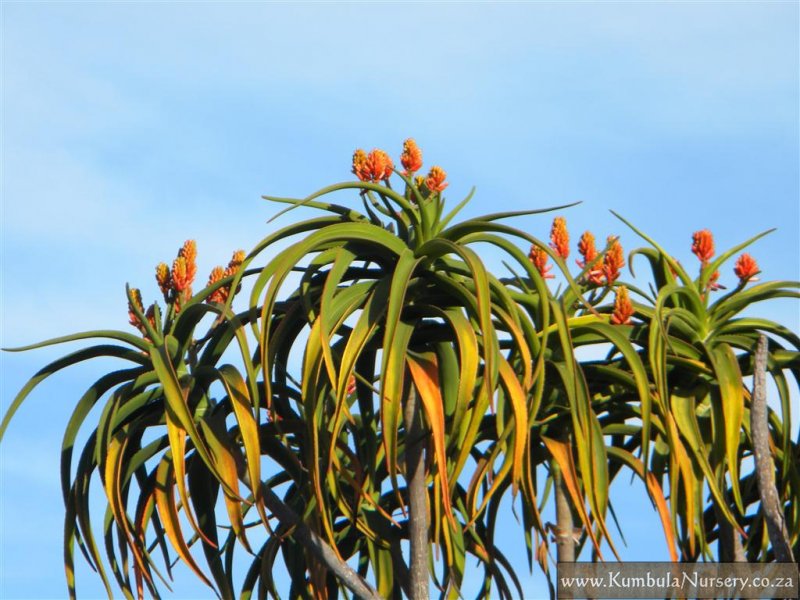
As long as there are no soft or rotten spots, this is perfectly normal. As aloes age their lower leaves die off. In most tall aloes the leaves crowd around the stem for years, but with the tree aloe, leaves are shed and fall off. The specimen in the photo below is, I think, about the same age and size as yours and you can see the lower leaves yellowing and dropping off. This only seems to happen once the plant has reached a certain age or level of growth. You can also see this in the fourth picture above.
I really don't think you need to worry. If the tree were dying from too much water, rotting would start at the root and it wouldn't be long before the plant would fall over.
Kind regards
Lorraine
containers
I live in Durbanville, western cape. I would like to plant some tree aloes in containers next to my home. I see on your website that they can be used in containers. Do they need eventual planting out or will they adapt to container life?
Tree aloes in containers
Hi Theresa
They should be good for perhaps 4 or 5 years or longer, depending on the size of the container and the efficiency of the drainage holes. Eventually the roots will find their way through the drainage holes and block them resulting in water logging and root rot, or they will crack their pots. The trees will then need to be planted out. At this stage their roots will be pot bound which will involve careful root cutting and sturdy, long term support of the plants until they are sufficiently anchored into the ground.
Kind regards
Lorraine
Aloe barberae planted to close to the house?
I recently planted 3 Aloe barberae next to my house, they are planted about 3 meters apart but about half a meter from the house wall. Only now have I done some research and found out how big these Aloes become and that they are planted to close to the house wall. From your experience what would be a suitable distance to plant these aloes away from a permanent structure? I could transplant them a further half a meter from the wall, but would 1m be enough?
Thank you for your advice,
Regards,
Paul.
Planting distance from permanent structures
Hi Paul
Any tree planted close to a wall, especially that of the house, will become a problem in later years, by which time the damage has already been done. For myself, I would not plant any tree closer than 4 - 5 meters away, but you could go down to 2 meters if you do not live in an area with strong winds. This may sound a lot at the moment but plants tend to grow way beyond our ability to visualise their effect. The closer a tree is to the house, the greater the damage if it falls on the house.
Problems with Aloe barberae too close to the wall:
*Although the roots are unlikely to crack foundations, the ever thickening base of this aloe will be strong enough to do so.
*Branches may break and fall on the roof causing costly damage and possible injury to inhabitants.
*The shape of the tree will be compromised in that the growth will be one-sided, the weight thus putting strain on the root system which could give way and the tree will fall down.
*Alternatively, the trunk will begin to bend from the weight of the branches and may break off completely.
*As with any plant, the tree loses leaves which will have to be regularly removed from the roof to prevent gutter blockage.
Hopes this helps with your decision.
Kind regards
Lorraine
ground covers with similar watering requirements
hi, can you advise which ground covers or shrubs i can plant under tree aloes, that will have the same or similar watering requirements? thanks
Hi Volker
Hi Volker
As you will have gathered from reading the above information, the Tree aloe prefers a moderate amount of water for optimum growth but is also able to survive dry conditions, in which case the growth of the tree will be slower. This allows a very wide selection of plants that you could grow in the area around the tree.
Your choice will be determined two conditions: the climate of the area in which you live, and the water available to you, taking into consideration the constraints of drought periods and water restrictions.
If you wish for specific suggestions, please furnish me with your area and water availability so that I can provide you with appropriate recommendations.
Kind regards
Lorraine
Aloe tree in container going brown on tips
Hi have recently been given a aloe tree in a container by a friend which is a meter in hight I have notice that the tree is going brown on the tips and couple of the branches are soft and draping , pls can you advice me why this is and how to prevent it, also I would like to keep it in the container is this is ok .
Tree aloe in container
Hi Mariam
It sounds as through the plant is getting too little water and perhaps not enough nutrients. It is possible that the container is too small so the roots may be taking up all the space. It may be time to re-pot the plant, prune the roots back and replant it with new, nutrient rich soil.
Kind regards
Lorraine
Aloe Barberae
Hi there. Please have a look at this photo. What is wrong with these plants and can they recover?
Ailing Tree Aloes
Hi Rosa
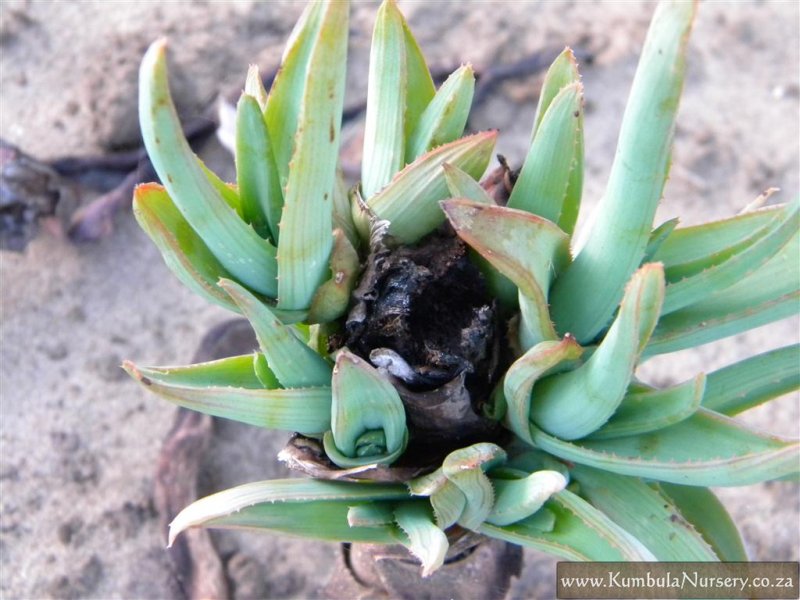
It is really difficult to tell, but it appears to me that this damage may be a result of Snout beetle. The single aloe certainly looks as though it has been attacked some time ago, hence the skinny little head coming out of the middle. You'll need to climb up a ladder to look into the centre of the leaves. If you see what appears to be black rot in the centre, then it is definitely Snout Beetle, in which case go to: http://kumbulanursery.co.za/blog/snout-beetle-damage-done-to-aloes
The aloes may also have been attacked aphid in the centre, in which case use any aphid control measures. Also look for ant activity, as aphids and ants go hand in hand. I have even had ants nesting in the trunk of one of my aloes.
If neither of the above seems to be apparent, please photograph the centre of the aloes so I can possibly make an alternative identification.
The trees will recover from either of the above problems if they receive timeous intervention.
Kind regards
Lorraine
Aloe Barberae - Indoor - Black spots & brown ends
My Aloe Barberae has black spots on it, more at the base where it meets the trunk. Some are small, but others are larger. What is it? How can I treat it? I have not had very good luck hearing from anyone that is familiar with this plant in Arizona AND it is indoors. One person suggested a mixture of Dawn soap & water then hose off. It would be difficult to hose it off as it is in my living room. More importantly, I do not know what I am treating and want to treat it accordingly.
I live north of Phoenix, (zone 9b) in the foothills (Tonto Forest Area). We tend to run about 5-8 degrees cooler than Phoenix along with more wind.
About 2+ months ago (Sept 2014) I purchased an African Neanderthal Aloe Tree aka Aloe Barberae aka Giant Aloe Tree... from a local nursery. That being said, they didn't even tell me the type of "tree" it was. Had I known how large they get, I would have not made the purchase as it is in my living room.
They called it an "Aloe Tree" and said that it would be "great" for my south facing Living Room with the entire length of the eastern and southern walls being floor to ceiling windows. The tree is about 10 feet tall and 5 inches in diameter, the ceiling is another 10 feet, so it has plenty of room still.
The nursery I bought it from had just transplanted it into a pot 25 inches diameter & 30 inches tall, saying it should be "fine" for several years". At this point I do not know if even the very limited amount of information I was given, is correct. I cannot move it outside at this point, my HOA will not allow it, so I am hoping that people can assist me with supporting it as an indoor plant.
I do not know how long they had it at the nursery. They had it under the building overhang, in an enclosed courtyard, with heavy screen/netting as a roof.
I thought it was stunning & bought it. Upon delivery I noticed the black spots, I feel that they are not a good sign... but have not been able to confirm from any of the 3 nurseries I have asked.
I am not sure how to do the following:
1- How do I get rid of the black spots? What are they?
2-How often should I water? Lately, it seams like a few stems are drying up & twisting - Is it thirsty? Could this be normal? Could it be in shock from moving? Or could be ...?
3- Is the pot large enough for now, 25 inches across and 24 inches deep?
4- Do I need to supplement it with additional lighting? I have a canister bulb directly above it, should I put in a special bulb to increase light?
5- Some of the tips are drying up and turning brown, is this normal or is there another issue?
6- If I am able to move it to my back yard/patio can it stay in the pot?
7- If I move it outside, should I wait until spring? It is getting colder by the day (mid-November) and down to 40 degrees at night.
I love this tree and REALLY want to help it, you cannot see in the photos but that is the extent of the wall for the next 15 feet along it is ceiling to floor windows and then the window-wall angles across the entire length of the room in front of the tree.
Any help and or suggestions would be welcome, I have read about others that have successfully grown these indoors, or healed it from the spots.
Aloe barberae - black spots photos
Photos of aloe and black spots.
Black spot on Tree Aloe
Hi Tami
Living as I do in South Africa, I have had no experience in growing this aloe indoors so I'll answer your questions as best I can. But first I must say that it never ceases to amaze me how nurseries will say just about anything for the sake of a sale. And whose vivid imagination came up with the name African Neanderthal Aloe Tree!? The mind boggles.
Here are my thoughts in answer to your questions:
Black spots: This is most likely a variety of rust caused by a fungus or bacteria. It often starts in the base of the leaf where water is captured or where debris gathers, on soft leaves due to too little sunshine and free air flow and on plants experiencing stress from compromised root systems, poor drainage, too much water and a humid environment. You can treat this using commercial fungus and bacteria products. You won't be able to get rid of the spots though - treatment will just prevent the fungus from spreading further.
Watering: Allow the soil to dry out between waterings. You mention that some stems seem to be drying but I can't see evidence of this on the photos. Did you perhaps mean leaves? As with all plants, aloes also shed old leaves, usually from the base or lower leaves. This is quite normal but might have been hastened by the shock of both re-planting as well as the change of environment.
Pot size: this sounds okay.
Lighting: You could try better lighting but to be honest the plant needs direct sunshine and freely moving air to keep it at its best. Your pictures indicate that the new growth looks soft and could be getting lanky. Too much water and too little light, I think.
Tips drying out: This is usually the first indication that a leaf is getting old and is going to die off. This is quite a slow process and is usually found only on the lower leaves.
Moving the aloe outdoors: This would be a healthy change for the plant. It can stay in the pot but may need to be re-potted or planted out some time in the future.
When to move: This depends on how cold your winters get, how much frost you have and how well your patio is protected from the worst of the weather. It may be better to move it in spring so it has time to adjust. The tree aloe can cope with a little frost but not severe, extended periods of frost. However I have heard reports that this tree is grown in some very cold areas but survive due to the environment of the micro-climate in which they are situated.
(I did make a small change to your post by the way. I thought the diameter of the tree to be more likely 5 inches rather than 5 feet.)
I hope the above gives you some direction. Do contact me again if you need clarification or just to let me know if you have managed to prevent any further spread of the rust.
Kind regards
Lorraine
Hi. I have an aloe about ten
Hi. I have an aloe about ten years old now, in New Zealand, and I wonder when it will flower?
Tree aloe - New Zealand
Hi Debs
It should have flowered by now. There could be any number of reasons for the tree not having flowered. I would need much more information to try to make suggestions: temperatures, habitat, rainfall, position and amount of sunshine and if possible, a couple of photos.
Kind regards
Lorraine
Aloe Barberae
Hi there we live in South Africa and have a beach house on the Wild Coast . We have planted a couple of Aloe Barberae and one has developed black markings, that do not appear to have any yellow or broken. Please advise what it is and how to treat it?
Thanks
Marilyn
Black markings on aloe leaves
Hi Marilyn
Please refer to the comment above listed as: Black spot on Tree Aloe.
Kind regards
Lorraine
Single Stem Tree Aloe Cutting
Hi There, I have two 3.5-4m tall single stem Aloe Barberae trees. I still have them in pots, but have had to shift the pots to avoid them growing up into and getting damaged by other Palm trees. At what height should they start branching out and can I cut the single heads off to force them to branch out, similar to how you would do with a Yucca? And, would I still be able to plant the cut off head as a separate plant? Appreciate your help and advice. Thanks, Sam
Forcing branching in aloes
Hi Sam
Your aloes should have branched out by now so I understand your concern.
You can cut the heads off to force branching out. I have no idea how quickly a Yucca would recover, but the re-growth with your aloes will be a slow process. I have included two images below of aloes re-branching after they had been injured. New buds may form around the cut end, or along the stem, or both. In the first picture, there were so many new buds that I removed a few that were getting squashed, dried them out and rooted them separately.
The cut off heads will root successfully as long as you are patient. Refer to the first comment above about planting truncheons. The drying out process is critical so don't rush to plant your truncheons. In order to prevent damage while drying, I would advise you to lay the truncheons on a bench or other structure to keep them off the ground, and to turn them over once a week so that they do not become flattened on one side.
I must add that while aloes are extremely adaptable to abuse and in most cases will continue to grow and thrive, there is no guarantee that the plant will recover from this procedure.
Kind regards
Lorraine
Branching Aloe Bainesii
I am curious what can be done to encourage an Aloe Bainesii to branch... a lot. See the photo below from my neighborhood in California. I love the look of this specimen, and wonder if something was done to keep it both small and branching? For example, is it possible to prune or cut a young plant to encourage branching?
Branching Aloe barberae
Hi Joel
Your query arrived before I had answered the one before, and it basically answers your questions. If there is anything I have not covered in the previous comment, let me know.
Kind regards
Lorraine
Aloe Barbarae
I planted a tree two or three years back. It is about 1.5m tall. There seems to be no or little growth. I see some new leaves coming out at the top, but only 2 or 3. Could I accelerate growth?? Are some trees simply stunted ( Inferior) and should simply be replaced
Slow growth of Tree aloe
Hi Gary
I really need a bit more information to be able to make a useful comment: Where you are, soil type, situation of plant, water supply and ideally, a picture of the whole plant and the crown of the aloe.
Kind regards
Lorraine
Aloe Barbarae
Fourways just North of Johannesburg. It is a frost area, so I will cover fronds this Winter. Soil seems good and well composted. Watered daily using Shrub sparyers on an irrigation system.Plant in a bed next to pool with at least 1m open bed all round.
Sickly Tree aloe in Gauteng
Hi Gary
Thanks for the information. I see that the frost caught the leaves during winter.
Cold weather, icy winds and frost will all play a part in slowing and stunting the growth of this aloe. As the climate of Gauteng is innately unsuitable for this aloe, it follows that its growth will be negatively impacted. In its natural sub-tropical habitat, the tree grows and flowers during the warm winter months, but in areas with cold winters this growth period is cut off.
The damage to the leaves also has a negative impact - as the plant attempts to recover from the damage, new growth is put on hold. Summer is the resting time for this plant and by the time the new growth season starts in about April, the cold arrives and sets it back all over again.
Another problem area for this plant is that it is getting far too much water. It's natural preference is for dry rocky slopes and dry forested areas.The amount of water your aloe is receiving is enough to place it in a stress situation. Aloes in general cannot tolerate having wet feet. I am honestly surprised that it has not already succumbed to root rot.
Your aloe is not a dud. It is simply not in the right place. Another specimen will not fare any better as it will have the same conditions to deal with. If you can move the aloe to a spot in the garden where it is well drained and dry, with perhaps a little frost protection from a tree or two, the plant is most likely to make some recovery. It will not, however, reach the majestic proportions which it would given better circumstances.
I am sorry that I cannot give you a more positive reply.
Kind regards
Lorraine
How fast does a Tree aloe grow?
I have added this comment to show the growth rate of a specimen in my garden, to give an idea of expected growth in a dry, frost free environment. This aloe is planted in very stony soil with no added nutrients, and receives water only during our infrequent rains.
Picture 1: This specimen was three years old when it was planted into this position.
Picture 2: Growth after two and a half years, at age five and a half years.
Picture 3: Growth after a further 16 months. The tree is a few months short of 7 years old.
Lorraine
Using leaves to propagate Tree Aloe
Hi Lorraine. Is it possible to successfully propagate Tree Aloe using their.leaves? Kind regards, Rob
Propagating Aloes from leaves
Hi Rob
Although most succulents can be propagated from leaves, the Aloe is not one of them. The only way to root an aloe from a leaf is by removing a good piece of the stem along with the leaf. As I have never tried this, I cannot say how efficient the system is or whether it will work with the Tree aloe. I found the following forum with more information on how it is done:
http://forums.gardenweb.com/discussions/1842166/aloe-plicatilis-leaf-cut...
There are many sites explaining how to root Aloe vera from leaf sections only but this aloe seems to be the exception to the rule.
Kind regards
Lorraine
cuttings from a tree aloe
Morning, I planted a tree aloe a few years ago, it got damaged when we off loaded it - the damaged area produced about 9 'babies'. We are moving end July 2015 I cannot take my original plant with me as it is about 4m tall, has 3 heads and about 9 'babies' 50cm+ each. Can I cut the babies in July to transplant later in August. My concern is moving plants during Winter - I live in Krugersdorp(JHB West Rand and will be moving to Roodekrans also West Rand)
Removing 'pups' from aloes
Hi Linda
There should be no problem with removing the babies or 'pups', although at 50 centimetres, they are hardly babies any more! I have removed pups from many types of aloes without concern for the time of year and have never had a problem - I don't think it matters. The amount of time between cutting and planting sounds fine. Keep the cuttings dry in a shady place during this time. Protect them from icy cold and frost.
Kind regards
Lorraine
aloes
thank you I appreciate the feed back - regards
Planting Tree Aloes from "slips"
Hi Lorraine, we were given two pieces of Tree Aloe broken off from the parent plant. We dug holes, poured in some bone meal and stuck the Tree Aloes in. It took quite a while but both Tree Aloes are now growing. I'm not sure if you can grow one from a leaf section though :-)
Propagating Tree aloes from pups
Hi Lilian
Thanks for your input. It does indeed take quite a long time for the cuttings to root but as long as they have dried out before planting, they do eventually send out roots and grow.
The bone meal is not really necessary, by the way. You can read more about the myth of bone meal at:
http://puyallup.wsu.edu/~Linda%20Chalker-Scott/Horticultural%20Myths_fil...
Kind regards
Lorraine
Aloe barberae
Hi,
I want to cut this tree at the positions shown.
I understand the procedure from above of replanting the truncheons.
My question is will the base continue to grow with no leaves when I cut at C and D also which is the best angle to cut.
Will the 2 sections AC and BD survive if treated as truncheons.
Thanks
Glen
Aloe Barberae truncheons
Hi Glen
In time the base stem an/or branches should produce nodules which will develop into leaves. Nothing guaranteed but aloes have an amazing ability to regenerate themselves - be patient though as this could take quite a while.
I cut my aloe stems flat, not angled, as the stem is very fibrous and I figure that the less exposed the inner stem is, the better.
Sections AC and BD may grow - it is certainly worth a try. At odd times I have cast aside an aloe stem (not A. barberea though) only to discover it months later with new pups growing all along the length.
Most important: adhere to the drying out process and at all costs prevent water-logging of planted stems. The use of coarse river sand at the bottom of the hole is the best way to do this. Don't plant too deeply - 15 - 20 cm is sufficient. Rather use supports if the truncheon is unsteady.
Do keep in touch and some photos of your results would be really interesting.
Kind regards
Lorraine
Aloe tree
Hi Lorraine. How long does a tree aloe usually take before it flowers. Many thanks
Flowering age of Aloe Barberae
Hi Gertie
I have found no documented mention of the age at which this aloe begins to flower but it will be dependant on the size and age of the original truncheon/seedling, habitat suitability, weather, climate, position, soil, water and so on. Where conditions are not to the plant's liking, it may never flower at all.
Mine seem to flower between 10 and 12 years old.
Has anyone else had experience with this?
Kind regards
Lorraine
yellow branches of Aloe bainesii
Hello, I recently planted an aloe bainesii a few months ago. I live near the coast in California and the soil is claylike. It gets full sun. I amended the soil to provide better drainage and water it 2x/week,for 5 min each time on a drip system. The lower branches began to turn yellow/orange then it spread to pretty much the entire tree. There are also black spots on some of the branches. I am worried it will die. What do you think is the problem and what is your recommendation? Thanks!
Tree aloe - leaves yellowing, clayey soil and black spots
Hi Stephani
I'll deal with the black spots first. This is a variety of rust caused by a fungus or bacteria. It is usually found on plants experiencing stress from compromised root systems, poor drainage, too much or too little water or a very humid environment. You can treat this using commercial fungus and bacteria products. You won't be able to get rid of the spots though - treatment will just prevent the fungus from spreading further. The only way to rid the plant of the black spots is to cut off the leaves.
In this case, it is clear that the tree is suffering from stress. Finding the reason, however, is not so clear.
Watering:
Here is an excerpt from the text above:
Habitat: '... in dry forests or dense tall woodland, generally in east-facing kloofs, river valleys and occasionally in exposed rocky places.'
Although an aloe, the Tree aloe grows in the wetter parts of South Africa, so you can't treat it like other aloes. It needs sufficient water to thrive. From your description of how it is being watered, and the yellowing of the leaves, it would appear to me that your plant is getting way too little water.
Clay soil:
Here is another excerpt from the text above:
Planting Suggestions: 'Aloe Barberae needs well-drained soil, preferably on a slope. It should be well watered and be given enough compost to provide for optimal growth.'
As to the clay soil, it depends on how much clay we are dealing with. As long as the clay is porous enough to drain the water away relatively quickly, there should be no problem with water-logging.
This is what I would probably do:
Clear the gravel and cautiously remove some of the soil around the roots - they are quite shallow. Pour a bucket of water over the roots. If the water does not drain away within a few minutes, there is perhaps too much clay. In this case, support the tree with some poles, dig under the tree and place some rocks and stones below and around the base of the tree, amongst the roots, filling in with very sandy soil as you go. Water well and replace the gravel.
Of course, if the water drains away quite quickly, this need not be done - all the plant needs is more water and perhaps a boost of some slow release organic fertilizer pellets. Spread these up to 2 meters around the tree - the roots travel very long distances.
Conversely, if the water does not drain away for some time, the tree will be easily waterlogged and the roots will rot. If this is the case, you would have to build a small, raised hillock of rocks and sandy loam so that the main roots and tree base are raised above the clay soil and have sufficient drainage. You would have to give the tree some serious support for a few months after this so that it can anchor itself back into the ground and not fall over.
Hope this makes sense and gives you something to go on.
Kind regards
Lorraine
tree aloe frost bitten
hi
we live in Dunedin, New Zealand and have a tree aloe approximately 1.6 metres high, unfortunately it has been bitten by the frost this year and the leaves have become mushy and yellow. the tree is 7-8 years old and we would like to know what to do to bring it back to life, it is our pride and joy in our back yard.
Thanks
Frost bitten Tree Aloe
Hi Fee
Oh what a shame! There is not much you can do to revive your tree. Simply put, once the water-filled cells have been frozen, the cell walls disintegrate and the damage cannot be repaired. The leaves then rot and this could travel down the stems as well. The only solution I can suggest is to cut the heads off to the point where only healthy stem tissue remains, protect the plant from further frost with a frost blanket or other covering, and hope for the best. Wait a few months and with luck, the tree may send out new buds. Please keep in touch and let me know how the tree progresses.
Kind regards
Lorraine
White stuff on my tree aloe
Hi, my tree aloe is looking very sick. It is tall so I. Ant reach it, but I need to sort out the disease it has. Could you help identify what is on the leaves, is it curable and if so, what would do the trick?
White scale
Hi Moira
I'd be surprised if your aloe is still alive. This is clearly an extreme case of White Scale infection - the worst I have ever seen. The tree must have had this condition for a long time for it to have reached this crisis point. White scale is a small insect that sucks the sap out of the aloe. If left untreated the insect will eventually cover the plant and kill it, as can be seen in your photo.
You can use any aerosol with contact insecticide but I believe it is too late for that - and as you say, you can't reach the leaves.
In your position I would cut off the entire heads well below the damaged area and burn them or have them removed from your property to a municipal dump where they will be less likely to infest other aloes. I would then spray the stems with a contact insecticide and wait for a few months. Aloes can take an amazing amount of punishment, and with luck and a lot of patience you may see new buds emerging. If there are other aloes in the vicinity, be sure to act fast and destroy the pests immediately you see them. They start off as just a few white dots, below the leaves or at the tips of the leaves. This also goes for aloes in the properties around you, as they may also have been infected.
Kind regards
Lorraine
Aloe Tree Shriveling
I have an Aloe tree that I planted in the ground from a pot (approx 10 years old at the time). It's been in the ground for 5 years now and has been doing quite well. I noticed that the upper trunk areas (at the branching off area) are starting to shrivel up. I can press these areas with my fingers and they are a little soft. (see attached pix) I live in Los Angeles and we have had a 4 year drought , so I cut back on above ground watering this summer. There is an underground drip system in place that currently waters the plant twice a week. Any Ideas on what would cause the shriveling? I love this tree and I don't want to lose it.Thanks-Mike
Tree aloe in stress
Hi Mike
I have not come across an aloe tree with this sponginess in the stem. The fact that your tree has rust on the leaves is indicative however, that your tree is suffering from stress, and I think it may be that it is not getting enough water.
The natural habitat of the Tree aloe, as stated in the above text, is as follows: '... in dry forests or dense tall woodland, generally in east-facing kloofs, river valleys and occasionally in exposed rocky places.'
Although an aloe, the Tree aloe grows in the wetter parts of South Africa, so one can't treat it like other aloes. It needs sufficient water to thrive. From your description of how it is being watered, the yellowing of the leaves and the spongy stem, it would appear to me that your plant is getting way too little water.
To deal with the rust on the leaves, please read the comment below: "Treating black spot, correctly known as 'Rust'"
Kind regards
Lorraine
Aloe Bainesii Black spot disease
I have two larger 24" box size Aloe Bainesii that were recently planted in my front yard I noticed black spots on the leaves and the ends of the leaves turning brown. On you page you mentioned this could be treated with commercial Fungus and Bacteria products. Could you recommend a type as there are many on the market and I would prefer not to experiment to find the right one? i.e the type of chemical or brand would at least help point me in the right direction.
thanks,
Steve
Treating black spot, correctly known as 'Rust'
Hi Steve
I can unfortunately not give you any recent information about the chemicals used for rust, as I have not used chemicals for over ten years. My 'poison book' (published in 1988) suggests the chemical 'mancozeb' should be present.
However, I would like to quote from the 'Guide to the Aloes of South Africa' Ben-Erik van Wyk and Gideon Smith; Briza publications, 2008, page 24, with regard to controlling rust:
"Neglected and non-vigorous plants are particularly prone to the disease..... Unfortunately, treatment with systemic fungicides is rarely effective. The best way to address the problem is to cut away the diseased leaves and to improve the vigour of the plant by regular feeding and watering."
I did find that fungicides were of little help and the ugly spots were there until the leaves died. I now hack off leaves at the first sign of rust, give the plant some food, and try to remember to water it occasionally.
Kind regards
Lorraine
Tree Aloe
Hallo Lorraine, Thank you I have found your website very informative. I am very worried about the position of my 3 aloe trees. They are all to close to my house - I plan to cut the heads off (they each have long stems) dry them out and re plant them per your suggestion. Should we then rather remove the stems completely - do we throw it away - is someone interested in the stems (trees are approx 3 - 4M high). Lastly one of the tree's leaves are completely covered in a white fluffy (mealie bug?) and we have sprayed the tree with recommended pesticide but to no avail. What do you suggest and what causes it?
Regards, Corrie
Moving tree aloe stumps and dealing with White scale
Hi Corrie
I would definitely remove the stems as aloes are very hardy and are able to overcome the worst sort of treatment. You could dig out the stumps with some of the root - they have quite shallow root systems - dry them out for a couple of weeks or more, and re-plant them. They will probably re-grow. Other than that I would probably get rid of them unless you can find someone who wants them.
I have never come across mealy bug attacking aloe but aloes do get another white insect that may appear similar. It is called White Scale. If left untreated the plant will become covered and it will die. This pest will also spread very quickly to other aloes. My aloe book suggests the use of any aerosol contact insecticide, which makes this job quick and easy. I have yet to find an organic insecticide that works for this.
Kind regards
Lorraine
Advice and recommended treatment
I recently bought three tree aloes and planted them in pots. Something has been attacking this one and the plant as a whole is starting to suffer. It started out with little white bumps around a dark spot and now looks like the image below. Can you advise on what is causing this and how I should treat it.
Thank you very much
Kindest regards
Elona
Ailing aloe
Hi Elona
My apologies for taking so long to reply to your query.
I am afraid I have never seen anything like this before. The first thing I would do is cut off the leaf and burn it or wrap in up and put it in the bin. If the damage has traveled down into the lower part of the leaf, I would keep going, removing damaged tissue until I came to healthy tissue. After this it would be a good idea to dust the cut areas with an anti-fungal powder. If however, the lower part of the leaf is healthy, then this is not likely to be the cause of the plant looking poorly - unless there are more infestations like this.
Because I tend to be a bit aggressive with failing plants, I would probably cut off all leaves that look suspect and wait to see what happens.
Sorry I can't be of more help. Perhaps another reader will be able to shed some light on this.
Kind regards
Lorraine
Aloe Barberae - planing seeds
How long does it take for seeds to germinate?
Germination time
Hi Ben
I have never grown seeds of this aloe but other aloe seeds I have planted have germinated within a couple of weeks. If they haven't germinated after a month, then I assume they are dud seeds.
Kind regards
Lorraine
Aloe barberae
Hello loarraine,
I recently purchased a aloe tree to place in a large pot. My concern is that the pot my not be big enough. The pot measurements are 650mm deep and 950mm wide. The base of plant/root ball is about 550mm tall. Which only leaves me 100mm below. Just wondering how long do you think it will last in the pot untill it outgrows it. The plant is about 2.5 meter tall. It receives nearly full sun all day in Western Australia. Thank you
Tree aloes and containers
Hi Chris
My sincere apologies for not having replied to your query so long ago. Life kind of got in the way.
You have probably found out by now that your tree will outgrow the pot in a very short time. Although it has recently become common practice to containerise young tree aloes, one tends to forget the facts:
They are not trees and as such cannot be stunted as with true trees; and they grow from 10 to 16 meters tall. They are great for containers for a while but will need to be planted in the ground sooner or later.
Plants always surprise us with their adaptability. Tree aloes originate from a mild climate where they grow in coastal and valley forest with a fair amount of shade, so I am most interested in knowing how your plant has adapted to a container in full sun. Do please give me some feed-back and perhaps a photo - useful feed-back for other readers.
Kind regards
Lorraine
Aloe tree branching
When does an aloe tree starting to branch off into more stems, does it happens naturally??....
Branching of Tree aloe
Hi Willie
They do eventually branch off naturally. After 5 years mine was 2m tall with only one stalk. During the next two years it just took off and now has three major branches and seven massive heads.
Kind regards
Lorraine
Aloe Bainesii trees
Hi there, I have a few beautifully growing mature trees planted in a large concrete build planter box thats about 1.5 meters in width and 4 in lenght. I have 3 trees in it. Recently I noticed some roots that have pushed their way through. I love the trees and hate to get rid of them. Any suggestions what I can do? Would digging it out and cutting some roots of damage the trees? Thought maybe replanting them would be better option if I cut few stems off, they all just ideas not really sure what to do. Any input would be highly appreciated.
Kind Regards
Aga
Tree aloes out-growing their space
Hi Aga
My sincere apologies for not having answered your query of such a long time ago.
It would be interesting to know the age and size of the trees. Tree aloes grow very large and there comes a time when they can no longer be contained in a small space. They not only have a vigorous root system, but as the tree matures, the base of the tree grows outward, which fact may not necessarily be observed from above the ground.
Apart from the danger of inviting disease or rot by cutting the roots, you may also find that the plants will be stimulated to increase root growth as a result of this perceived 'invasion'.
You can try uprooting them and cutting the roots. If you take this route the plants must then be placed in the shade for anything from two weeks (very small trees) to two months (large trees) while the cuts heal and dry out. Only after this can the trees be replanted.
You can cut stems off. Where the stems have been cut, anything from a few buds to up to twelve buds will arise from the cut area. You can break most of these off and leave just a couple.
The bottom line is that any attempt to stunt a tree aloe will cause stress to the plant. Aloes that become stressed are a magnet for insect and fungal
attacks. When they have outgrown their allotted container space, they need to be planted in the ground.
I'd be interested to know what route you have taken.
Kind regards
Lorraine
Hi I just noticed that the
Hi I just noticed that the very middle leaves of my aloe barberae were soft and after touching them 3-4 leaves just fell out. Will the centre grow back? Will it stunt the groth or worse die?
Snout beetle
Hi Tania
Apologies for my tardy reply.
Your aloe has been attacked by Snout beetle. Go to: http://kumbulanursery.co.za/blog/snout-beetle-damage-done-to-aloes
to find out more about this rather disgusting pest.
Check with a knitting needle, sharp stick or screwdriver to see if the larva is still inside the aloe stem - you may have to poke around a bit as they can be quite deeply buried in the mess. If so, hook it out. If not it means that it has finished its cycle and the beetle has left the plant. If the damage is not too deep, the plant will grow back from the centre. If the damage has killed off the whole growing point and the end is squashy androtting, cut the stem below the rotten section and leave it to dry.
After some time (weeks...months...) small buds will appear on the stem from which new rosettes will grow. In the meantime, water as usual and of course, don't over-water.
Kind regards
Lorraine
Tree Aloe
Hi, We have a tree aloe(800mm) that the leaves have died, but when i dug it up there was one new root and the older roots are greenish, the stem is also still green, savable?
Thanks
Audrey
Tree aloe stump without leaves
My apologies for taking so long to reply.
Yes the plant is saveable. Just replant to the original depth, stake so that movement is restricted and be patient. It may take 6 months to a year before it is able to anchor itself in the soil but it will send out new buds from which branches will grow.
Kind regards
Lorraine
Aloe Barberae fungal infection
Hi Lorraine, we recently ‘inherited’ a mature aloe which had outgrown it’s container. It has been replanted into the ground having sustained some damage during transportation. It is happily now showing signs of new growth. However we note what appears to be a fungus going on some of the bigger branches. Is this an infestation which we should worry about and if so, how should we treat it. We live on the mountainside in Simon’s Town. Kind regards, Gavin
Bracket fungus on tree aloe
Hi Gavin
Apologies for taking so long to reply.
This is a bracket fungus that usually grows on dead wood but if the tree is growing, I don't think you have anything to worry about. From the picture the outer wood does look pretty dead but aloes are hardy and the inner part of the stem must be fine or the aloe would not be growing. It is possible that the 'dead' outer bark may slough off with time. I am guessing but you could knock off the fungus growths - this may discourage it to some extent.
Hope this helps.
Kind regards
Lorraine
aloe stems root ball
hi I have some aloe trees, the root ball and the stem appears to be flaking away
from being too wet, the pervious owner covered with soil well above the root line
can I save them can I just chop the old root ball of and repot
Rotting aloe roots
Hi Rob. Apologies for the tardy reply - hope I am not too late.
You will need to cut off all damaged root and stem so that only fresh, clean flesh remains. Dry the whole plant in the shade for about a month before re-planting. You can read more about this in two of the comments below this one.
Kind regards
Lorraine
Hi Lorraine
Hi Lorraine
I have a medium sized tree aloe on our verge and unfortunately the garden service weed-eaters got too close to the bottom of the stem and nicked it - the result is that the stem is damaged (see picture). I am concerned that as the tree grows and gets heavier, the stem will not be able to support it properly. I have staked it in the mean time. Do you think I should replant the entire tree and sink the damaged part beneath the ground? thank you, Margot
Damaged trunk of Tree Aloe
Hi Margot
I had a similar problem with another large aloe variety. All went well for a couple of years until a heavy gust of wind took the whole plant down. I agree with you that this could happen with your plant as the damage is quite severe.
This is what I would do:
Cut the stem neatly through the damaged part. Place the whole tree in the shade of a tree or under a carport for 4 to 6 weeks, Turn the tree periodically to keep the shape intact.
Prepare a hole. The stem should not be planted more than about 20 cm deep. Make a deeper hole and fill the base with clean river sand. Plant the tree so that the stump is surround by the sand under the ground. Stake securely with three or four sturdy, tall stakes so that the plant is held firmly in place, especially in wind. Leave the stakes in for at least a year so that the tree can anchor itself. Once anchored, begin to loosen the stakes gradually over the next 6 months to allow some movement in wind, until the tree is secure and solidly rooted and then remove the stakes.
During this time make sure the tree is watered but allow the soil to dry between waterings. A saucer built around the tree will be useful so that you water deeply rather than frequently. Your biggest enemy during this time will be rotting from over-watering. This is one of the times when 'less is more'.
This is a long process and you will need patience and some strong-armed help. Whoever does the job, hover. Make sure it is done exactly how you want it done.
All the best and keep in touch. Send photos as you go - I and other readers would love to see the process and results.
Kind regards
Lorraine
Thanks Lorraine, will give it
Thanks Lorraine, will give it a try
Cuttings
Gday, u have been offered a cutting from a large aloe tree, approx 2.5 tall. Will this size be able to grow from a cutting if I let it sit in the shade for a month or is it too large? Thank you
Large cutting
Hi Chris
I can't see why not. A month in the shade should do. When you plant, put a good amount of coarse sand into the hole so that the base is surrounded by the sand. Don't plant too deeply - about 20 cm should do. You will need to stake it for about a year or more before it is able to anchor itself and stand alone - use three or four stakes around the plant. Allow soil to dry between waterings to prevent rotting.
Kind regards
Lorraine
Tree Aloe rotting
Hi
We have recently planted two aloe trees into pots with soil provided by the nursery they came from. We noticed the leaves dying off. Not knowing what the problem was we looked into everything and eventually noticed that the soil is far too wet.
I am in the process of changing the soil, but need to know if the plants will survive? Is there anything I can do to make the process a successful one?
The roots have rotted and the stem has also partially rotted.
I would really appreciate any assistance.
Thank you
Jean
Rotting roots and stem of tree aloe
My sincere apologies for taking so long to reply - I can see why you are so anxious.
You should be able to save these plants if you follow the instructions, which may seem rather odd to you.
Cut off all rotten parts plus about 10 - 15cm of healthy stem above this. (The experts will suggest that you dust the cut with anti-fungal powder, which is probably a good idea in this case.) Now put your plants in a shady spot and leave them to dry out for a minimum of two weeks for a thin stem and 4 - 6 weeks for thicker stems. The cut stems must be absolutely dry before re-planting. Do not be afraid - I have left aloes out of the ground for 4 months and more without killing them.
When re-planting, place some coarse river sand at the base of the hole so the bottom of the stem will be surrounded with quick draining soil. Don't plant too deeply - 10-15cm should do. Use stones/rocks/stakes to help with balance until the plants make new roots. This can take a long time - up to 6 months before they are anchored. As you now know, don't over-water...Allow soil to dry out between waterings but also don't let them roast in the sun if they are in pots. Temperature in pots in the sun can cook the roots inside.
Keep in touch and let me know how it goes.
Kind regards
Lorraine
Discuss this plant
Share knowledge, ask a question or give an experience.