| Botanical Name |
|
| Family |
Rubiaceae - The gardenia and coffee family. |
| Pronunciation |
gar-DEEN-ya thun-BER-jee-uh |
| Common Name(s) |
English: White gardenia; Forest gardenia; Wild gardenia
Afrikaans: Witkatjiepiering; Buffelsbal
IsiZulu: umValasangweni; umKhwakhwane
|
| Plant Group |
- Tree A woody, self-supporting perennial plant usually with a single main stem and generally growing more than 6 meters tall.
|
| Plant Size |
- Small
| Tree | 4m to 8m |
| Shrub | 50cm to 75cm |
| Perennial/ground cover | 10cm to 20cm |
| Bulb | 20cm to 30cm |
| Succulent | 10cm to 20cm |
- Very Small
| Tree | 3m to 4m |
| Shrub | 25cm to 50cm |
| Perennial/ground cover | Up to 10cm |
| Bulb | 10cm to 20cm |
| Succulent | Up to 5cm |
|
| Position |
- Canopy Shade Canopy shade is found below closely grown trees where some light filters through. Ideal for the protection of herbaceous plants.
- Light or Dappled Shade Found below trees with sparse, open foliage. Ideal for the protection of herbaceous plants.
- Partial Shade The area is in shade for part of the day and in full sun for part of the day.
- Sun The area is in full sun for all or most of the day, all year round.
|
| General Information |
- Attractive fruits, berries or seeds Brightly coloured fruits or berries increase and extend the visual impact of the plant and are especially attractive to birds and other small wildlife.
- Drought Tolerance: Moderate The plant is moderately adapted to arid conditions and can survive short periods of drought and high temperatures without extra water.
- Evergreen Plants that have leaves all year round.
- Fragrant / Aromatic These plants posses a strong, usually pleasant odour.
- Frost: Half-hardy The plant is able to survive low temperatures and some frost but requires protection against severe frost.
- Sand tolerant Plants adapted to survive in nutrient poor, very sandy soils.
- Water Loving Plants need a regular supply of water and must not be allowed to dry out for any length of time.
- Water Moderate These plants will need some extra watering compared to water-wise plants. Plant them together, in at least some shade and in a convenient proximity to the house so that grey water can be utilised during times of drought.
|
| Specific Information |
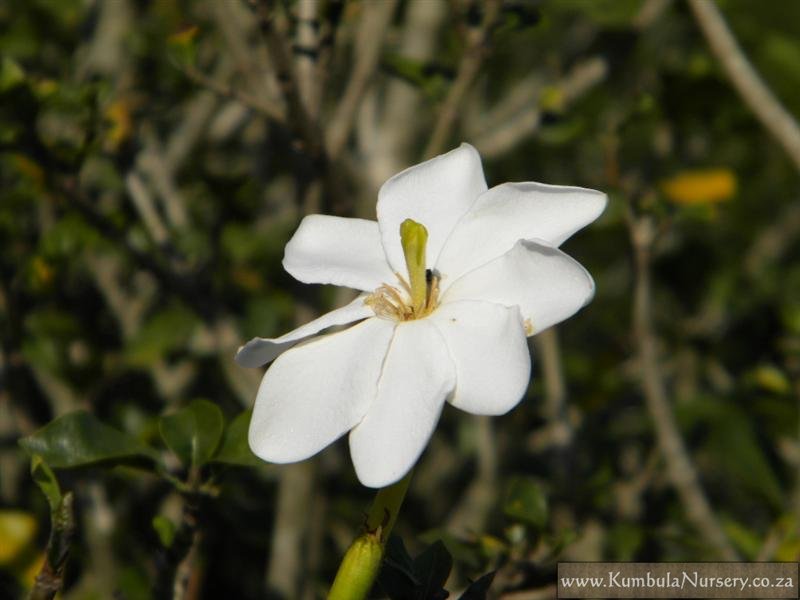
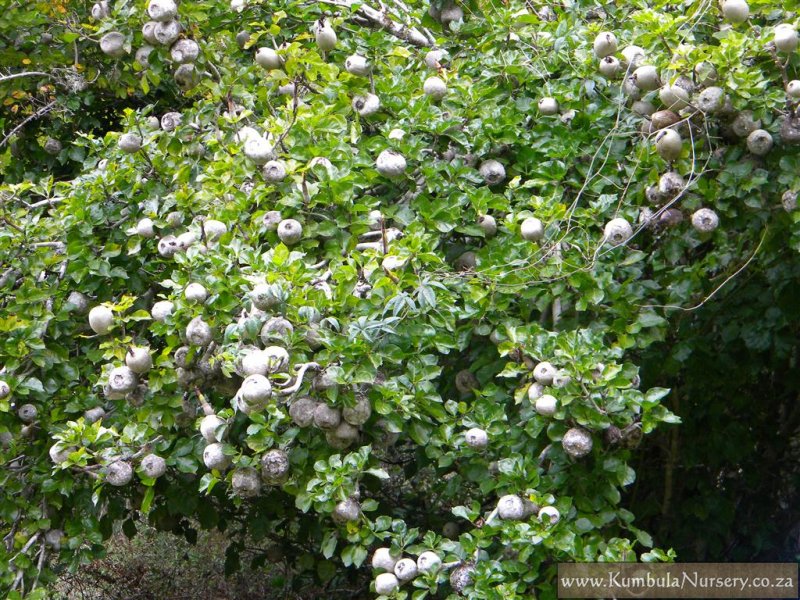
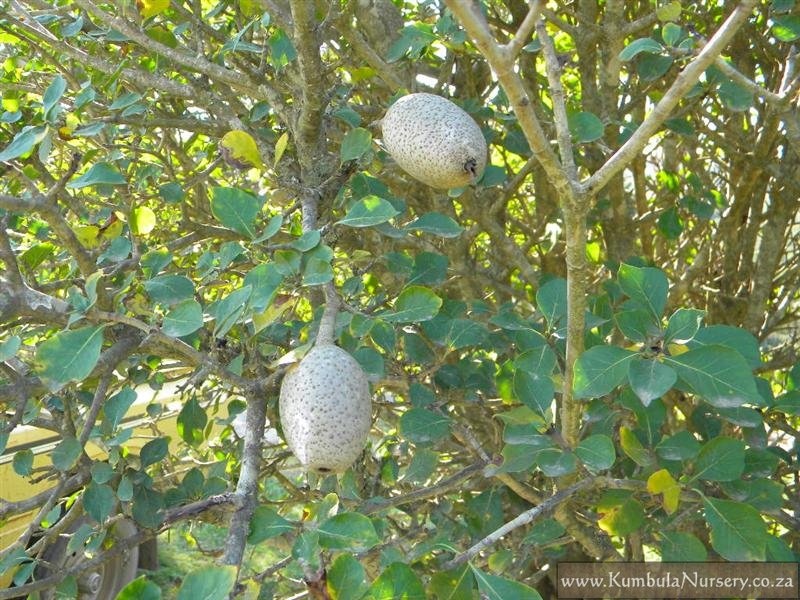
Gardenia thunbergia has pale grey bark, short rigid branches and glossy light green leaves. The large, tropical looking flowers are strongly perfumed, notably at night. The fruits are egg-shaped, about the size of a child's fist, and are tough and fibrous. In the past in their natural habitat they were eagerly eaten by elephants and other large large animals but no longer having this method of dispersal, the fruits can remain on the plant for years.
|
| Ad Break |
|
| Flowers |
| Description |
trumpet shaped opening to 8 large 'petals'
|
| Season |
- Summer Plants will seldom bloom for the entire season as given in the list, but should flower during a period within these parameters.
|
| Colour |
|
| Growth Rate |
- Slow Specifying growth rate can be very misleading as there is considerable variation of growth rate depending on type and species of plant, available water, supplementary feeding, mulching and general care, as well as the plants suitability and adaptability to the garden environment.
|
| Plant Uses |
- Attracts bees, butterflies or other insects This plant attracts insects which can be food for birds or other creatures in your garden.
- Attracts Birds This plant will attract birds.
- Boundary A plant useful for planting around the edges of the property to form a green or colourful backdrop, an impenetrable hedge, to hide walls or create privacy.
- Container Trees, shrubs and ornamental species that can adapt to growing in a restricted environment.
- Filler Either a fast growing tree or shrub used temporarily to fill in an area while the permanent plants grow to a desired size, or a plant used to fill gaps in borders or beds.
- Provides light / dappled shade A tree with an open to sparse canopy, through which varying degrees of sunlight can penetrate.
- Suitable for bonsai A shrub or tree that lends itself to being dwarfed.
- Suitable for seaside gardens Plants that will survive the hostile environment of harsh salty winds, dry sandy soil, irregular rainfall and heat found in seaside gardens.
- Suitable for smaller gardens Such plants do not have invasive root systems, remain small or controllable and can often be grown in containers.
- Wild Garden An indigenous garden planted for the benefit of wildlife and birds. Provides food, water, a variety of mini-biomes and no poisonous chemicals are used.
- Windbreak Trees planted in a row to form protection from prevailing winds by breaking the force of the wind, thereby reducing wind damage.
|
| Distribution and Habitat |
along the coast from Grahamstown in the Eastern Cape to Kosi Bay in the north of KwaZulu-Natal, in evergreen forest and forest margins, less often in woodland and bushveld
|
| Planting Suggestions |
|
| Medicinal Uses |
The roots are reportedly used to treat skin diseases, skin lesions caused by leprosy and as an emetic against fever. The rootbark is used to treat biliousness and gall bladder complications. The roots and leaves are used to treat syphilis, and the latex is used as a purgative.
|
| Ad Break |
|






Comments
Good day
Good day
I've been looking for this indigenous plant at numerous nurseries in vain...Thank you for letting me know when it will be available again at your nursery?
Kind regards
Werner J. Kronenberg
gardenia thunbergia
the gardenia 3' with 3" of new growth, green and healthy was supposed to be a specimen plant in a garden bed under a native frangipani (hymenosporum)surrounded by 5 tibouchina dwarf form white. So far no fruit or flowers, have used charlie carp, seasol, chicken, cow poo and mushroom (no elephants) what else would you suggest?. After seeing your web page and found out it is a small tree can l prune to keep it at about 5'. l live in Melbourne Victoria.
Hi Christine
Thank you so much for your query. I realised that I had made a horrible error on the website with regards to the size of this plant. You have no need to worry about it outgrowing the space. It is unlikely to grow beyond 5 meters tall at the most. As to the flowering, it may be that your plant is still relatively young. The South African gardenias are really slow growing and slow growing plants often take a few years before they mature sufficiently to begin flowering. (My gardenia cornuta took about 8 years before it started to flower but I must admit it was not particularly well cared for.)
From your description it seems you have done all you can or should. 3 inches of new growth sounds pretty good to me. I am afraid you will just have to wait patiently. Unfortunately I was unable to find any information as to how old the plant should be before it flowers.
I am sorry I can't be of more help. You can get more detailed information about this plant at http://www.plantzafrica.com/frames/plantsfram.htm.
Kind regards
Lorraine
Where to find it in Gauteng
Hi I am interested in this plant but I have not seen it in a nursery in the Gauteng region. Do you know where I will be able to find it
Hunting for Gardenia in Gauteng
Hi Rudy
I found a nursery in Honeydew that has the plant listed in its plant availability list. Go to: http://www.ennisgardencentrecc.co.za/home
It may be easier to find Gardenia volkensii, common name Bushveld Gardenia, as its natural habitat is found in the provinces of Gauteng, KwaZulu-Natal, Limpopo, Mpumalanga and North West. You can get more information about this plant at the following sites:
http://redlist.sanbi.org/species.php?species=1412-21
http://www.plantzafrica.com/plantefg/gardeniavolk.htm
Images: https://www.google.co.za/search?q=Gardenia+volkensii&es_sm=93&tbm=isch&t...
Another very useful lead is Grow Wild. They list both of the above gardenias in their retail list, but contact them to see if they have the plants in stock: http://www.growwild.co.za/
Life is a garden, the website for the Garden Centre Association of S. A., makes mention of the tree in an article but as there are dozens of affiliated nurseries, I have no access to stock lists. Here is a list of the affiliate nurseries in Gauteng: http://lifeisagarden.co.za/GCA-Garden-Centres/gauteng
Kind regards
Lorraine
Thank you Lorraine. I will
Thank you Lorraine. I will definitly have a look at the links you sent me.
Gardenia thunbergia
I have had this plant growing in my garden at Hillville near Taree NSW Australia for nigh on twenty years. It suffered years of neglect, as in I was too busy to look after my garden properly, but since installing an irrigation system last year it finally decided to reward me by sending out seven enormous buds which unfurled into the most sumptuous smelling, gloriously beautiful, glistening white flowers with the petals arranged like the spokes on a parasol. The corolla tubes were about eight inches long, and the flowers large. The petals reflex backward after opening. The plant is now well over head high, growing beside a huge liquidamber on a bank. It is mulched every year when the tree loses it's leaves. I bought this plant at "The Fragrant Garden" at Erina on the Central Coast NSW, which has been closed for many years now. I also bought a specimen of Clethra arborea, the Lily Of The Valley tree last Sept from Dicksonia Rare Plants in Victoria. It has flowered for me over Christmas also. Every leaf axil. Superb!
Hi Railie
Hi Railie
Nice to hear from our friends Down Under. I have found our indigenous gardenias to be very forgiving. My Gardenia cornuta was also neglected for many years but has grown well and flowered generously for the last few years. I pass by the bush every evening at present to breathe in the gorgeous perfume.
I googled Lily Of The Valley tree but there are three trees with this common name:
Clethra arborea from Madeira;
Crinodendron patagua from Chile; and
Oxydendrum arboreum from North America
From the descriptions I would guess you have the first of these - a really beautiful tree. Seems it is uncommon in South Africa as I could not find any references to it being sold here.
Kind regards
Lorraine
Gardenia Thunbergia
We have had a Gardenia Thunbergia for at least 6 years. It looks very healthy with glossy green foliage and is about 1 meter tall. As yet we have had no flowers. What do we need to do to promote flowering ?
Flowering age for Gardenia thunbergia
Hi John
My sincere apologies for not having replied to your query.
I have no idea how old this plant should be before flowering. When I took over my mom's garden, her specimen must have been at least ten to 15 years old, about a meter tall but rather neglected, although there were a few fruits.
I gave it plenty of water, and a scattering of slow release, organic fertiliser and it produced a few more flowers the next season. During the subsequent seasons (without any further pampering) the quantity of flowers increased steadily and it now produces a satisfying mass.
I can't say whether the improved flowering was a result of the water and fertiliser or if the plant had reached maturity.
There are certain fertilisers available to promote flowering so you might use one of them, or just go with a good layer of Bounceback and a thick layer of mulch to keep the soil moist and friable.
Hope this will jolt the shrub into flowering.
Kind regards
Lorraine
Gardenia Tulbagia and stinkbugs
I have had a Gardenia T for a number of years and have always beenpresented with a wonderful display of those wonderfully scented white flowers.
But, and this is a big BUT. The shrub becomes home to hundreds of stink bugs, and the smell can be overpowering.
What can be done besides trying a bug repellant, which has not been effetive. Is the a naturl way of getting rid of them?
Regards
Max
A smelly problem
Hi Max
My sincere apologies for not having replied to your query earlier.
I'm stumped. What a horrible infestation. Perhaps someone out there has a suggestion.
Investigate the insecticides from Margerate Roberts - they are made from natural ingrediants and you might find one that works. Find them at your nursery.
Kind regards
Lorraine
Discuss this plant
Share knowledge, ask a question or give an experience.