| Botanical Name |
|
| Family |
Colchicaceae - The flame lily family. |
| Pronunciation |
glo-ree-OH-suh soo-PER-buh |
| Common Name(s) |
English: Flame lily; Turk's Cap
Afrikaans: Vlamlelie; Boslelie
IsiZulu: isimiselo; ihlamvu; isikhwali
|
| Plant Group |
- Bulb / Corm / Rhizome / Tuber / Epigeal bulb Bulbs: are made up of fleshy scales as in an onion
Corm: a short, swollen, underground stem that is hard and not fleshy as in a gladiolus
Tuber: a solid, fleshy, underground, storage organ as in a potato
Rhizome: an underground, horizontal, swollen stem at the base of the plant as in an iris
Epigeal bulb: bulbs that rest above the ground with only the roots anchoring the plant to the earth as in albuca
- Climber / Creeper Climber: a plant that climbs using tendrils or if given support.
Creeper: a plant running along the ground, often rooting as it goes.
|
| Plant Size |
|
| Position |
- Canopy Shade Canopy shade is found below closely grown trees where some light filters through. Ideal for the protection of herbaceous plants.
- Light or Dappled Shade Found below trees with sparse, open foliage. Ideal for the protection of herbaceous plants.
- Partial Shade The area is in shade for part of the day and in full sun for part of the day.
|
| General Information |
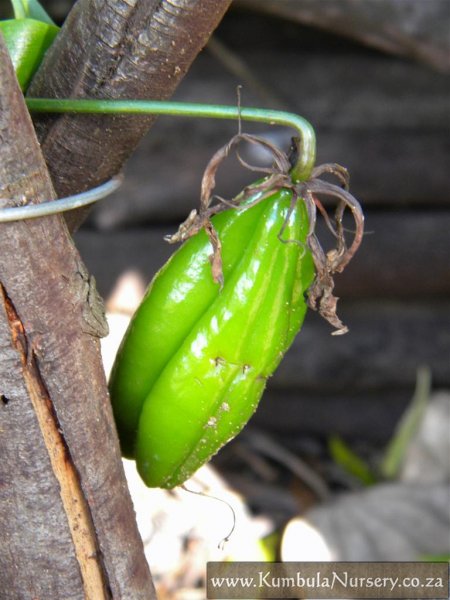
- Attractive fruits, berries or seeds Brightly coloured fruits or berries increase and extend the visual impact of the plant and are especially attractive to birds and other small wildlife.
- Deciduous Plants which completely lose their foliage for part of the year.
- Drought Tolerance: Moderate The plant is moderately adapted to arid conditions and can survive short periods of drought and high temperatures without extra water.
- Frost: Half-hardy The plant is able to survive low temperatures and some frost but requires protection against severe frost.
- Water Moderate These plants will need some extra watering compared to water-wise plants. Plant them together, in at least some shade and in a convenient proximity to the house so that grey water can be utilised during times of drought.
|
| Specific Information |
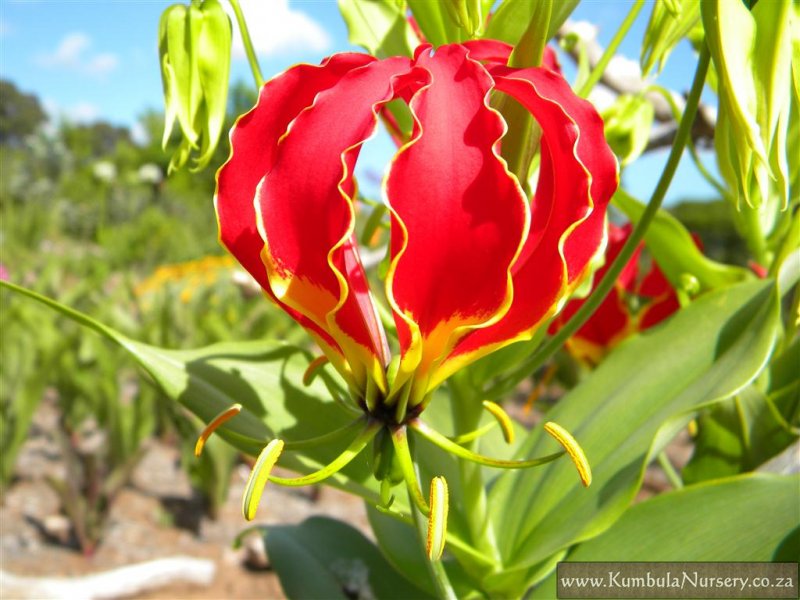
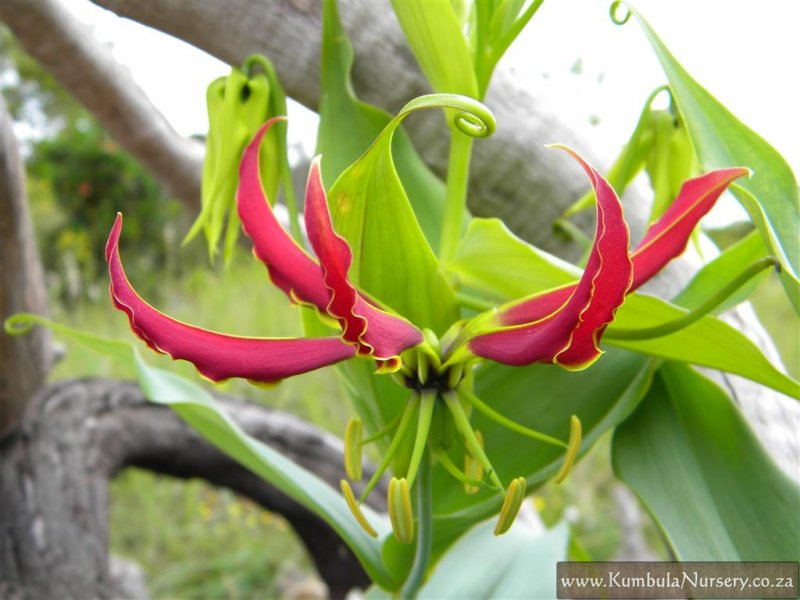
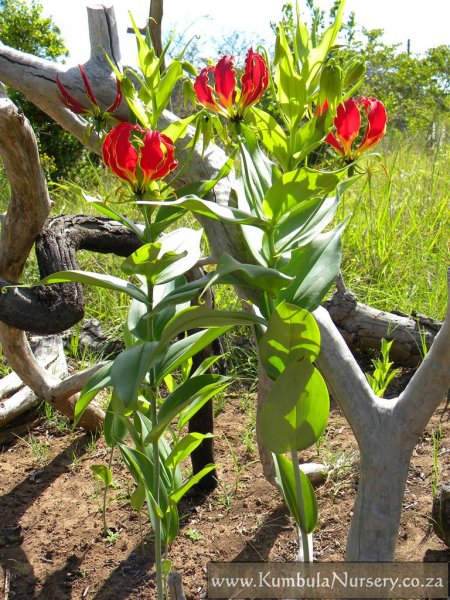
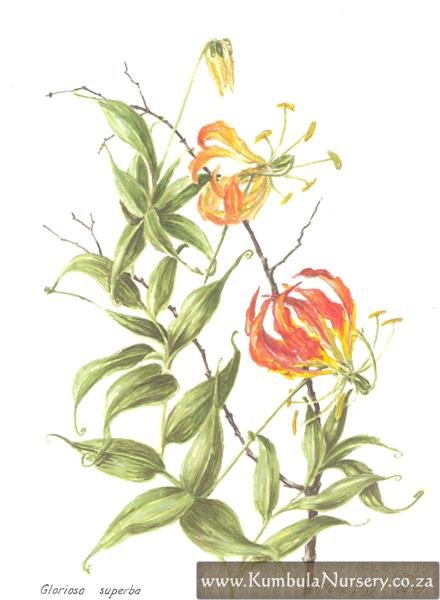
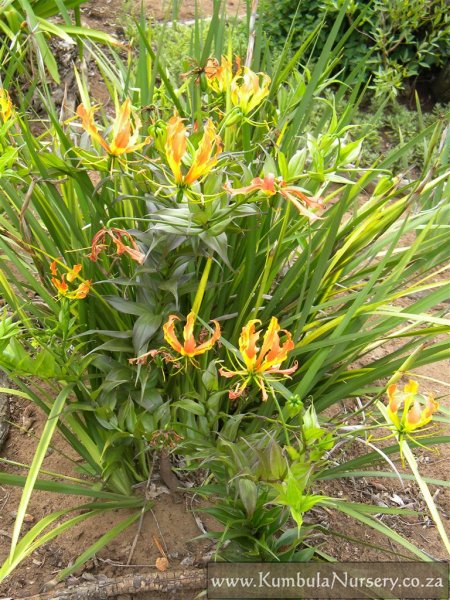
ALL parts of this plant are extremely poisonous and ingestion could be fatal. Gloriosa superba is a climbing or scrambling vine with glossy leaves, the tips of which coil onto nearby bushes, using them as a support. It grows from 1 to 3 meters from an underground tuber. The flowers are stunning in arrangements but do note that the orange pollen leaves an indelible stain. There is also a plain yellow variety.
Gloriosa superba is considered a rampant and dangerous invasive weed in parts of Australia, where it dominates coastal dunes at the expense of native species and has led to deaths of native animals and birds when ingested.
|
| Ad Break |
|
| Flowers |
| Description |
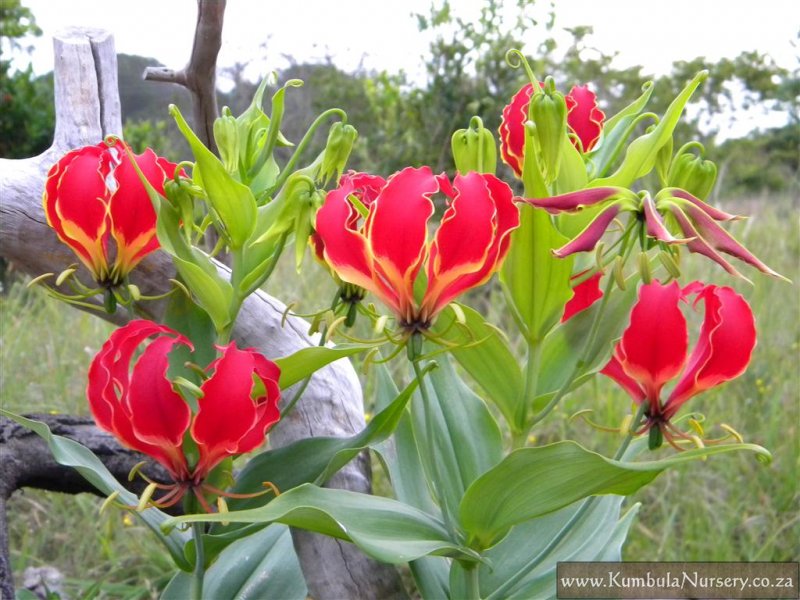
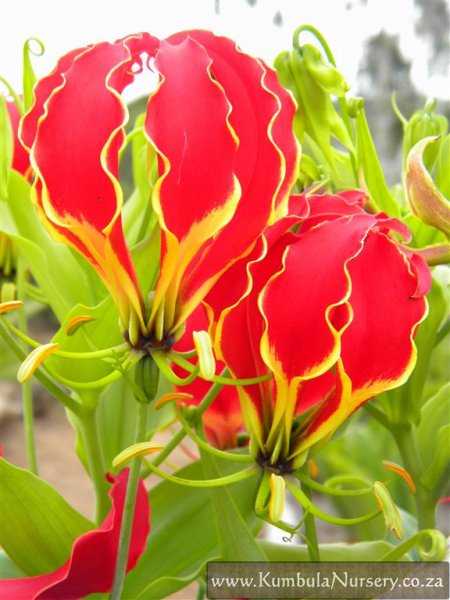
flame-like, wavy-edged petals that arch back, with the stamens radiating out from the base
|
| Season |
- Summer Plants will seldom bloom for the entire season as given in the list, but should flower during a period within these parameters.
|
| Colour |
|
| Growth Rate |
- Fast Specifying growth rate can be very misleading as there is considerable variation of growth rate depending on type and species of plant, available water, supplementary feeding, mulching and general care, as well as the plants suitability and adaptability to the garden environment.
|
| Plant Uses |
- Attracts bees, butterflies or other insects This plant attracts insects which can be food for birds or other creatures in your garden.
- Boundary A plant useful for planting around the edges of the property to form a green or colourful backdrop, an impenetrable hedge, to hide walls or create privacy.
- Container Trees, shrubs and ornamental species that can adapt to growing in a restricted environment.
- Cut Flowers Plants that provide flowers suitable for ornamental uses.
- Filler Either a fast growing tree or shrub used temporarily to fill in an area while the permanent plants grow to a desired size, or a plant used to fill gaps in borders or beds.
- Suitable for coastal gardens Plants adapted to dry, sandy soil, forceful wind, limited rainfall and intense sunlight.
- Suitable for smaller gardens Such plants do not have invasive root systems, remain small or controllable and can often be grown in containers.
- Wild Garden An indigenous garden planted for the benefit of wildlife and birds. Provides food, water, a variety of mini-biomes and no poisonous chemicals are used.
|
| Distribution and Habitat |
along the Eastern Cape coast to KwaZulu-Natal, Swaziland, Northern Province, Mpumalanga, Botswana, Namibia, and Zimbabwe, and throughout tropical and subtropical Africa and Asia, in nutrient-poor, fast-draining soils, in semi-shade areas on hillsides, in savanna bush and in thickets
|
| Planting Suggestions |
Choose a site where the flame lily can scramble up through trees and shrubs, or provide a trellis in a semi-shaded area, otherwise they flop on the ground or scramble over and through nearby plants. The tubers, which are brittle and fragile, can only be lifted and split or moved during the dormant period. Plant the tubers horizontally 8 to 10cm deep, in well drained soil. Water well during the growing and flowering season but reduce water during the winter resting period. If cultivated in the winter rainfall region it is best grown in pots, as the tubers are likely to rot during the wet winter months. Seeds take up to nine months to germinate. The vines dry up after seeding but don't bother with removing them - they disappear into the ground in no time at all.
|
| Medicinal Uses |
Gloiosa superba contains the poisonous compound colchicine and is used in folk remedies in Asia and southern Africa to treat intestinal worms, bruises, infertility, skin problems and impotence. The main use of colchicine is in the treatment for gout.
|
| Ad Break |
|






Comments
Flame lily/Spider Lily
I found this plant growing in our garden in Mossel Bay. I was fascinated by this flower and eventually found out the name from a nursery. I saw it the first time last year and then it dissappeared until end December when I again saw it amongst another plant. Where it came from I don't know, but it is lovely!
Gloriosa Superba -
Lorraine, the deep red variety with those large wide peatls is really a superb variety, hoping you'll get some seed setting this year. Remember I am first on the list for these seeds :)
Flame lily seeds
Hi Justin
I'll be watching them like a mother hen! You'll be the first, no second, to know if seeding occurs.
Regards
Lorraine
Gloriosa Superba
Thanks Lorraine, they really are magnificent! I know you're a person that's true to her word, holding thumbs for a good crop of seed, those plants in flower would sell like hot cakes!
Being a Rhodie, I was
Being a Rhodie, I was delighted with the surprise appearance of these lovely flowers the December I moved into my new house.. Every year they bloom in all their glory and I scatter the seeds around to propagate them further.
Hi Hilary
Hi Hilary
Thanks for your comment.
Yes, they really are one of my all time favourites. They even grew very well in Johannesburg when I was a child, but as the years passed they flowered later and later, eventually only flowering in February. They also became smaller and I wonder if it was a result of climate change, the quality of the water or perhaps acid rain. Here in Bathurst they are not as vigorous as they are in wetter areas but some years they are really stunning, as you can see from the photos.
Kind regards
Lorraine
Glorious Gloriosa
I've always loved these ever since I was a child seeing them growing on the sand dunes near our beach cottage in Southern Natal. I also remember being terribly excited when I saw a yellow one growing in the Kruger Park unfortunately there were a some elephants in my way or I would definitely have looked for a seedling or two. Just kidding.
It's a lovely thing to plant and forget in suitable summer rainfall areas. They also appear to be mole resistant which is handy. They definitely can become a pest in the garden so plant with care. Select your spot knowing you will probably never get rid of them, not easily at least. Attempts to dig up the deep rooted wonderfully weird shaped fat fingered V shaped bulbs are futile, they break very easily and it appears even the smallest piece manages to somehow grow, plus you will find many smaller cute sell sown bulbs looking like baby potatoes. They sink deeper and deeper into the soil each season. Pulling up the vines seems to stimulate even more shoots next year or even the same year. What exactly is going on under ground I'm not sure. I found this a problem when I've changed colour scheme for example, fiery red doesn't work very well with soft shell pinks........anyway planting them up a fence in the background hidden by taller shrubs and plants you can be sure of a lovely dsplay like little fires dancing along the top the fence every year where they look stunning against dark green. They make good cut flowers so don't be shy.
I found they thrive in any situation but generaly get their flowering done in the sunshine by clambering up and through whatever is in their way. To keep them wonderfully in check plant deeply in deep sand, even pure sand, in the sun and don't fertilise at all. This way they won't ramble but stand up dead straight about twenty cm tall like they do on the beach just before the tree line. This way they look lovely in short grasses and ground covers, have no fear they will pop up through anything except hard pan clay.. To keep dry in winter rainfall areas plant under sunny eaves, areas that stay dry all year, just remember to water in summer for a magic burst of growth.
Since living in Asia I've discovered some lovely colour varieties including all white from Japan and a deep chocolate purple imported from the Netherlands. This variety shown here with the broader petals looks stunning, very similar to G superba "Rothschildiana" one of mine and many other growers perennial favorites, though even the skinny twisted and frilly blooms of the wild ones look beautifully like little flames dancing in the wind and are often even more intensely red.
Hi Anton
Hi Anton
Apologies for taking so long to reply.
Thank you so much for your post. Lots of interesting information. As always, it amazes me how people from other countries appreciate, grow and hybridise our lovely plants while South Africans tend to take them for granted.
Sadly, this past year has been disastrous for my plants. After 30 years of ignoring them, the mole-rats ate the lot. I had always thought they would be safe as they are so poisonous. I haven't got a single one left. If I can get hold of some seeds or bulbs, I am going to try growing them in a very large, deep container. I can't bear the thought of not having any at all after I have grown up with them and had them all my life.
Kind regards
Lorraine
Discuss this plant
Share knowledge, ask a question or give an experience.