| Botanical Name |
Leonotis leonurus - hybrid Golden Velvet |
| Family |
Lamiaceae - The mint and salvia family |
| Pronunciation |
lee-oh-NO-tis lee-oh-NOR-uss |
| Common Name(s) |
English: Wild Dagga; Lion's Ear
Afrikaans: Wildedagga; Duiwelstabak
|
| Plant Group |
- Shrub A woody plant of relatively low height, having several stems arising from the base and lacking a single trunk; a bush.
|
| Plant Size |
- Medium
| Tree | 10m to 16m |
| Shrub | 1m to 2m |
| Perennial/ground cover | 40cm to 60cm |
| Bulb | 40cm to 60cm |
| Succulent | 40cm to 60cm |
|
| Position |
- Light or Dappled Shade Found below trees with sparse, open foliage. Ideal for the protection of herbaceous plants.
- Sun The area is in full sun for all or most of the day, all year round.
|
| General Information |
- Deciduous to Semi-deciduous In warmer areas a deciduous plant may not lose its leaves during winter at all, or may lose its leaves for a very brief period, or may only lose part of its foliage.
- Drought Tolerance: High The plant is well adapted to arid conditions; it can survive long periods of drought and high temperatures without extra water.
- Frost: Hardy The plant can withstand freezing temperatures or frost without artificial protection.
- Prune hard after flowering Fast growing shrubs that grow lanky within a season. Cut off branches and stems of these plants to a third of their original length. This will increase the yield of flowers, improve the plants shape and enhance the structural strength of main branches.
- Roots Non-invasive Safe to plant near pools, paving, walls or buildings.
- Sand tolerant Plants adapted to survive in nutrient poor, very sandy soils.
- Water Wise Plant species originating from low rainfall regions that require less water to survive and thrive than other plant species.
- Wind Tolerant Plants able to withstand the effect of strong winds.
|
| Specific Information |
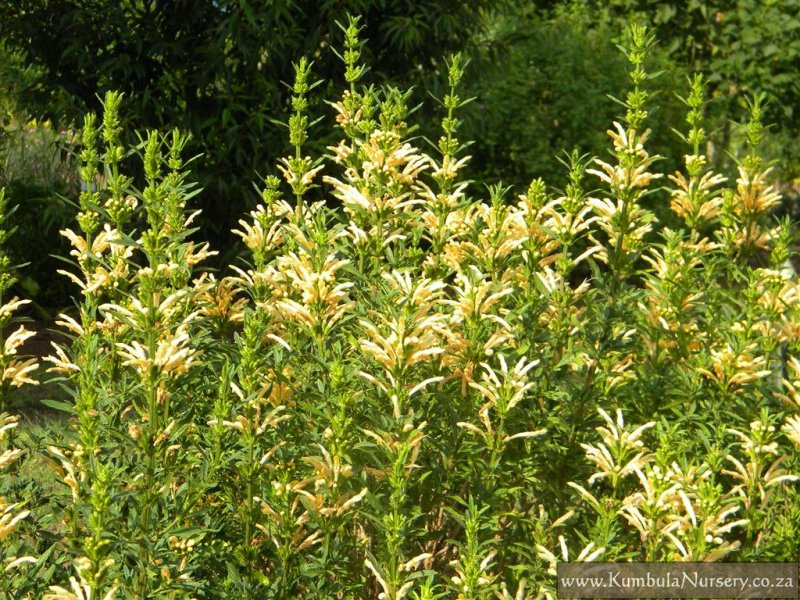
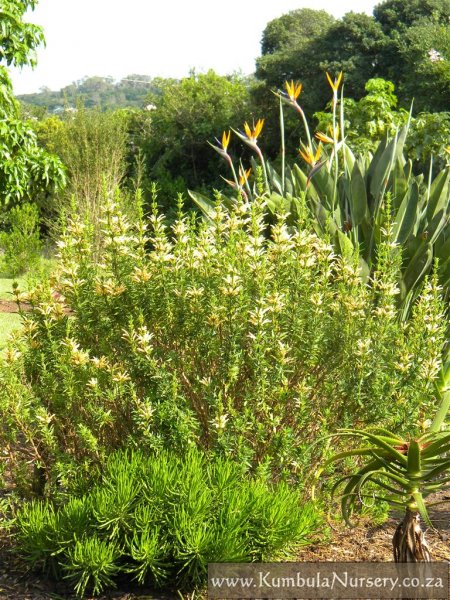
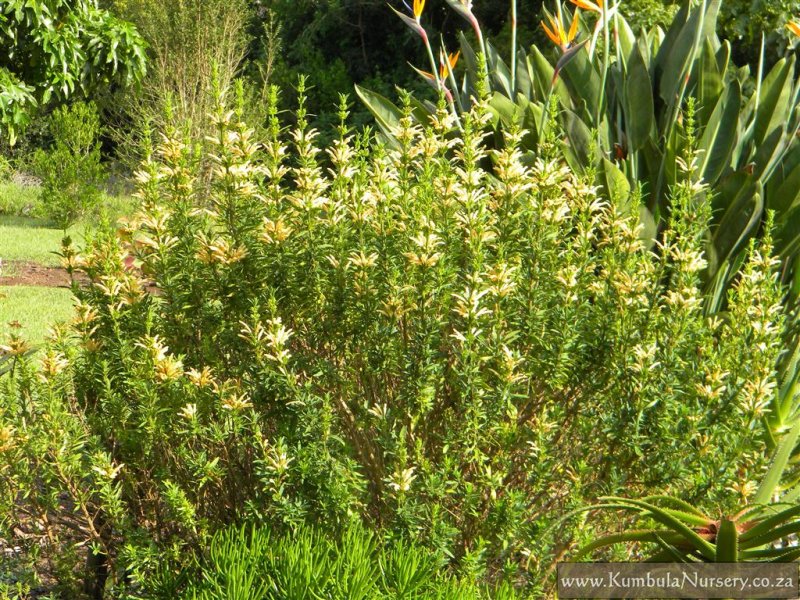
This Leonotis is a less robust shrub with smaller leaves than the wild variety. The flowers produce nectar in abundance making it an excellent plant for attracting birds, bees and butterflies. Although commonly called Wild dagga, this plant is not in any way related to Cannabis. This hybrid can tolerate a little shade during the day.
|
| Ad Break |
|
| Flowers |
| Description |
compact cluster of furry, tube-shaped flowers in whorls
|
| Season |
- Autumn to Winter Plants will seldom bloom for the entire season as given in the list, but should flower during a period within these parameters.
|
| Colour |
|
| Growth Rate |
- Moderate to Fast Specifying growth rate can be very misleading as there is considerable variation of growth rate depending on type and species of plant, available water, supplementary feeding, mulching and general care, as well as the plants suitability and adaptability to the garden environment.
|
| Plant Uses |
- Attracts bees, butterflies or other insects This plant attracts insects which can be food for birds or other creatures in your garden.
- Attracts Birds This plant will attract birds.
- Border A strip of ground, at the edge of a driveway or path in which ornamental plants or shrubs are planted.
- Boundary A plant useful for planting around the edges of the property to form a green or colourful backdrop, an impenetrable hedge, to hide walls or create privacy.
- Filler Either a fast growing tree or shrub used temporarily to fill in an area while the permanent plants grow to a desired size, or a plant used to fill gaps in borders or beds.
- Rock Garden An area constructed of larger rocks, arranged naturally, to emphasise the use of stones as a main element. Generally plants used do not need a lot of care.
- Suitable for coastal gardens Plants adapted to dry, sandy soil, forceful wind, limited rainfall and intense sunlight.
- Suitable for smaller gardens Such plants do not have invasive root systems, remain small or controllable and can often be grown in containers.
- Wild Garden An indigenous garden planted for the benefit of wildlife and birds. Provides food, water, a variety of mini-biomes and no poisonous chemicals are used.
|
| Distribution and Habitat |
|
| Planting Suggestions |
Plant in well-drained soil with a little compost. Mulch to retain moisture. To form a dense shrub and encourage flowering, tip off the growing points periodically during spring and early summer. Prune back hard at the end of winter.
|
| Medicinal Uses |
|
| Ad Break |
|







Comments
Frost tolerance
Hello,
I was wondering how this Leonotis is cold hardy? And what are they his parents (Leonotis leonorus x ... ?)to give him this hardiness.
Grettings from Bordeaux, France
Cold hardiness of Leonotis hybrid
Hi Vincent
Although this plant can cope with cold weather and frost, I doubt that it could stand long term icy weather where the ground freezes.
I do not know which species of Leonotis were used to create this hybrid, but it is probably a combination of the orange and white Leonotus leonorus. In general, I have found that hybrid plants are usually weaker than their natural counterparts.
Hope this helps.
Kind regards
Lorraine
Discuss this plant
Share knowledge, ask a question or give an experience.