| Botanical Name |
|
| Family |
Asteraceae - The daisy family. |
| Pronunciation |
GER-ber-a jay-mess-OWN-ee-eye |
| Common Name(s) |
English: Barberton daisy; Gerbera daisy
|
| Plant Group |
- Perennial A plant whose life cycle lasts for three or more seasons.
|
| Plant Size |
- Small to Medium
| Tree | 8m to 15m |
| Shrub | 75cm to 1m |
| Perennial/ground cover | 20cm to 40cm |
| Bulb | 30cm to 40cm |
| Succulent | 20cm to 40cm |
|
| Position |
- Partial Shade The area is in shade for part of the day and in full sun for part of the day.
- Sun The area is in full sun for all or most of the day, all year round.
|
| General Information |
- Deciduous to Semi-deciduous In warmer areas a deciduous plant may not lose its leaves during winter at all, or may lose its leaves for a very brief period, or may only lose part of its foliage.
- Drought Tolerance: Moderate The plant is moderately adapted to arid conditions and can survive short periods of drought and high temperatures without extra water.
- Frost: Half-hardy The plant is able to survive low temperatures and some frost but requires protection against severe frost.
- Water Moderate These plants will need some extra watering compared to water-wise plants. Plant them together, in at least some shade and in a convenient proximity to the house so that grey water can be utilised during times of drought.
|
| Specific Information |
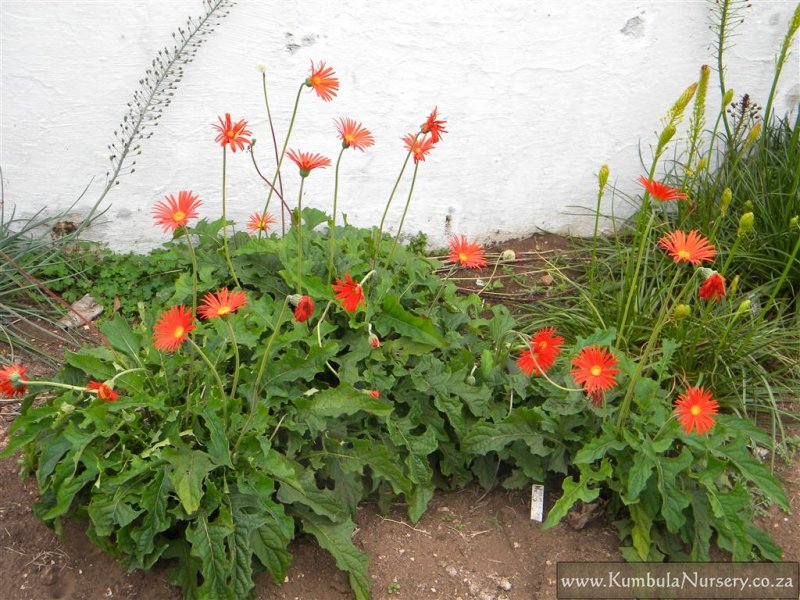
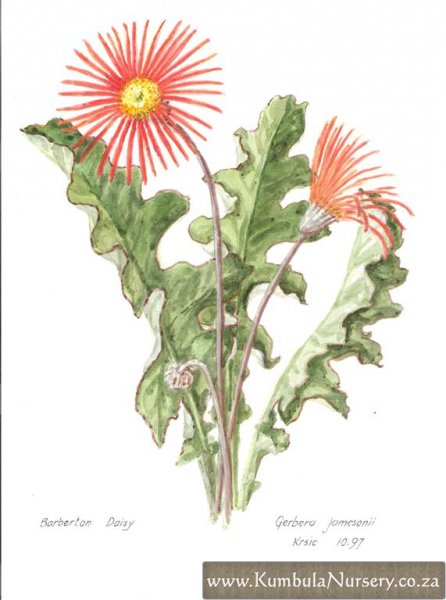
A popular garden plant, Gerbera jamesonii have deeply lobed, dark green leaves rising from a central crown. Leaf growth is particularly lush if the plants receive a little shade, but flowering will be reduced.
|
| Ad Break |
|
| Flowers |
| Description |
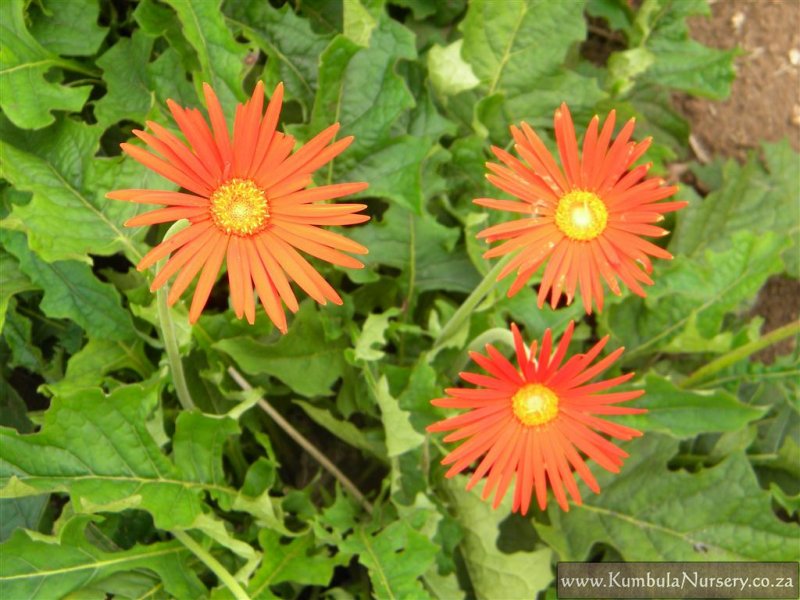
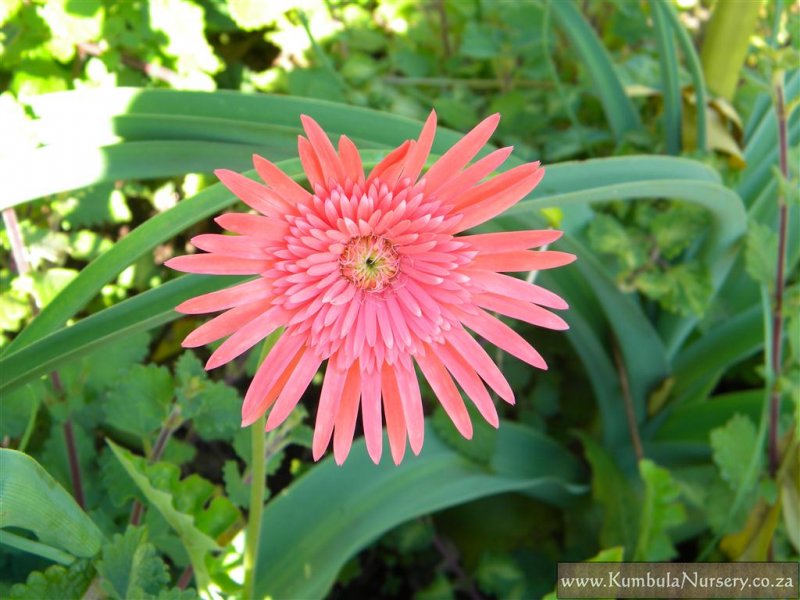
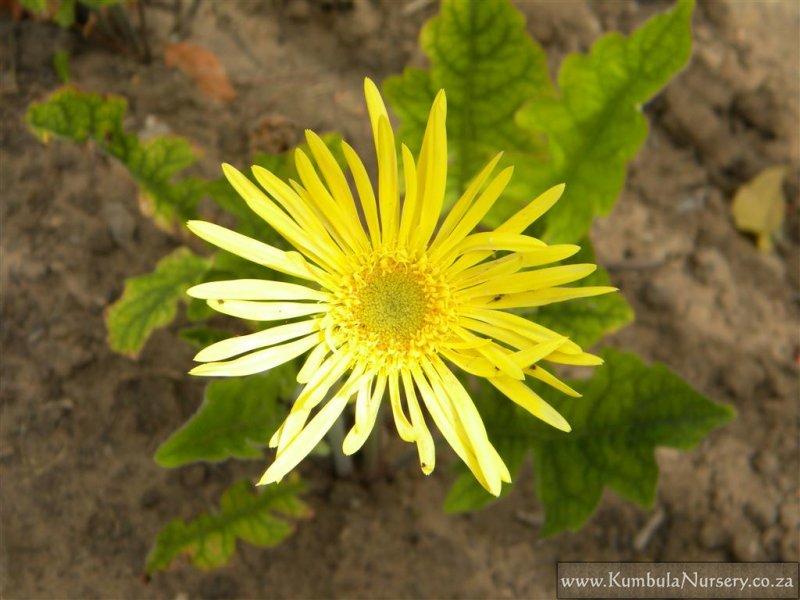
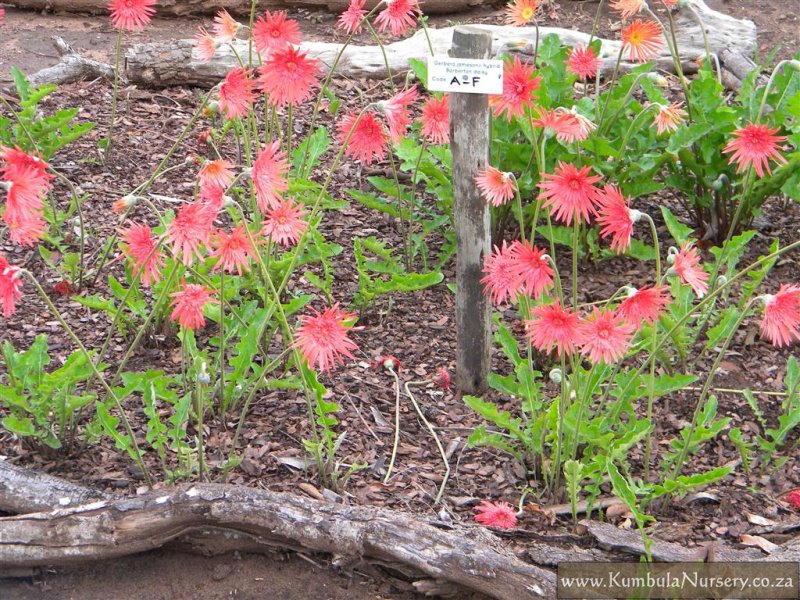
daisy with narrow, long petals on a long stalk, 7 - 10cm diameter
|
| Season |
- Autumn Plants will seldom bloom for the entire season as given in the list, but should flower during a period within these parameters.
- Spring Plants will seldom bloom for the entire season as given in the list, but should flower during a period within these parameters.
|
| Colour |
|
| Growth Rate |
- Moderate to Fast Specifying growth rate can be very misleading as there is considerable variation of growth rate depending on type and species of plant, available water, supplementary feeding, mulching and general care, as well as the plants suitability and adaptability to the garden environment.
|
| Plant Uses |
- Attracts bees, butterflies or other insects This plant attracts insects which can be food for birds or other creatures in your garden.
- Border A strip of ground, at the edge of a driveway or path in which ornamental plants or shrubs are planted.
- Container Trees, shrubs and ornamental species that can adapt to growing in a restricted environment.
- Cut Flowers Plants that provide flowers suitable for ornamental uses.
- Filler Either a fast growing tree or shrub used temporarily to fill in an area while the permanent plants grow to a desired size, or a plant used to fill gaps in borders or beds.
- Ground Cover Low-lying plants that spread fast, require minimal maintenance, and cover large expanses or bare areas between bulbs or shrubs. They provide protection from erosion and drought and improve the visual appearance of the garden.
- Interplanting Arranging and planting plants in the garden that have different blooming times and habits of growth, extending the amount of time in which the area is in flower.
- Mass Planting Plants useful for filling a large area with just one or a few kinds of plants spaced close together. Creates a bold, dramatic effect and to reduces maintenance.
- Pot Plant A plant that needs a protected environment on a patio or indoors.
- Rock Garden An area constructed of larger rocks, arranged naturally, to emphasise the use of stones as a main element. Generally plants used do not need a lot of care.
- Suitable for coastal gardens Plants adapted to dry, sandy soil, forceful wind, limited rainfall and intense sunlight.
- Wild Garden An indigenous garden planted for the benefit of wildlife and birds. Provides food, water, a variety of mini-biomes and no poisonous chemicals are used.
|
| Distribution and Habitat |
Mpumalanga, and Limpopo, in sandy, well-drained soils in grassland
|
| Planting Suggestions |
Gerbera need well drained soil. Ensure that the crowns are not buried and drainage is efficient or the plants will rot. Remove dead heads regularly to encourage a longer flowering period. It is recommended that clumps be divided in spring. They grow easily from seed which must be planted within two months of collection. Gerbera tend to contract some viral, bacterial and fungal diseases. I have found that fungal diseases are particularly persistent in our area but were not as evident in Gauteng. Slugs and snails can also be problematic.
|
| Medicinal Uses |
|
| Ad Break |
|





Comments
barberton daisy
I live in Jo'burg, and have been looking for the old fashion Baberton, could you please advise if you know any nurseries here that actually have them. Grew many different colours double and single in Zimbabawe, but cannot find them here
Thanks
Barberton daisy
It must be over 20 years since I last saw the old-fashioned gerberas for sale in Johannesburg. Those that I have come from stock my granny grew in our garden in Johannesburg some 40 years ago. Perhaps the Walter Sisulu Botanical Gardens, the Botanical Society in your area or one of the Indigenous Nurseries could help. Failing that, you can buy seed but it must be absolutely fresh - if it is older than 3 months, it probably will not grow.
Seed
HI, I am looking for seeds to plant, do you know were I can buy?
Regards
Ewoud
Gerbera Jamesonii seed availability
Hi Ewoud
I have tried pre-packed seed of Gerbera, occasionally found at supermarkets, nurseries and hardware stores, but not had any positive results. I do have seed for sale that is fresh, but even so, germination rate is low. If you wish to purchase seed, please email me at kumbulanursery@gmail.com, and I will supply further details.
Another reader bought rooted plants sent by speed post, and found this to be most satisfactory.
Battling to grow seeds
Recently I am really struggling to grow my daisy from seed. I have tried various ways such as 1: planting in best potting soil and mixing in a bit of loose soil 2: putting the containers in which I have planted the seeds into plastic bags
3: not covering the seeds with soil and leaving them exposed
4: Watering them from the bottom. So far I have been unsuccessful. I have been successful in the past so I am not sure if I am planting at the wrong time of the year.
Gerbera seed not germinating
Hi Gail
When I started out growing seeds of Gerbera, I had no luck whatsoever. I assumed that I what I was planting was viable seed. After about two seasons I realised that there were actually only a few viable seeds in each seed head. In the first picture, you can see what most of the 'seeds' I was planting look like. In the second picture you can see the difference - viable seeds are quite a bit larger and have a swollen base. These have to be planted very fresh or they will not germinate.
Could this be the reason for your lack of success?
Kind regards
Lorraine
illness of plant
The leaves of my Gerberas turn purple and then die, but it still flowers. It is as if the leaves die.
Gerbera: leaves turn purplish
Hi Sarita
This happens to my plants every year. At the moment they have almost no leaves but have up to twelve flower heads on one plant. This occured in Johannesburg as well as here in the Eastern Cape while the plant takes a rest during winter. I am not sure if this happens in Mpumalanga, where they grow wild and where the weather is warmer during winter.
I just remove the worst of the dead leaves, crunch them up and spread them under the plants to serve as mulch and to return the nutrients to the soil.
Kind regards
Lorraine
Discolouration of flowers
A chain store in a mall in Pretoria has been selling these beautiful flowers. I was given a pink one as a gift months ago. Planted it in full sun in potting soil in a container and fed frequently with Kelp. Never stopped flowering. Leaves lush. Bought 7 new ones in a range of gorgeous colours. Now pink one has green in petals and bright yellow petals are black behind petals. So sad! Could this be a fungal disease? How can I treat it? Many thanks!
Discolouration of flowers
Hi Pat
Unfortunately, without photos or more detailed information I am unable to make any definite assessment.
I have on occasion noticed among my own plants that at the end of a heavy flowering season the odd flower is discoloured, small or misshapen. If all the flowers are affected, this would indicate incorrect pH, too much/too little of one or other element in the soil or too much fertiliser or water. Also check for mites, whitefly, ants, aphids or any other small insect invasion.
The black behind the petals might be a fungus. You could use a chemical fungicide available from nurseries or hardware stores, or an organic fungicide which you can read about at: http://www.gardencare.co.za/profile_fungicides.htm
I must add that plants grown for quick sale in chain stores or nurseries are grown under cover with artificially controlled, very specific conditions of light, feeding and water supply, then chemically forced into flower. Plants grown under such pampered conditions are not resilient to change of environment and are susceptible to any number of bacterial or fungal diseases and insect attacks. On the whole these plants are created for an instant colour burst (usually to coincide with Mother's day, Easter or Christmas) with long term survival being of least importance.
If you send some photos of the affected flowers/plants, I may be able to be more specific.
Kind regards
Lorraine
Discuss this plant
Share knowledge, ask a question or give an experience.